
What Is Celadon Pottery?
By Linda · · 9 min read
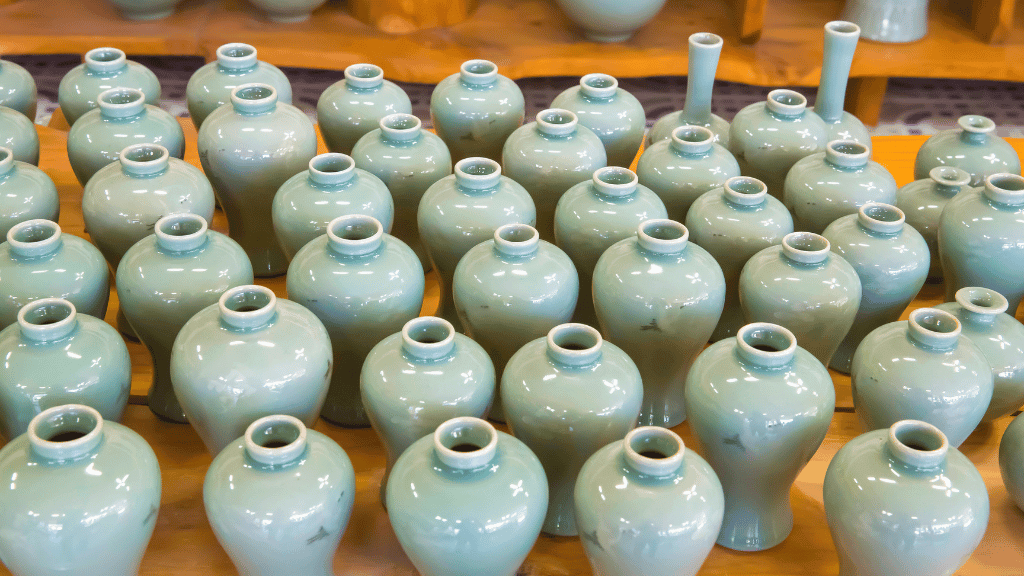
Celadon pottery is ceramic ware, usually stoneware or porcelain, coated with a translucent glaze that fires to a soft jade-green color. The green comes from a small amount of iron oxide (typically 1–3%) in the glaze, fired in a reduction atmosphere where the kiln is starved of oxygen.
The technique originated in China nearly two thousand years ago and was developed to imitate the look of carved jade. Today “celadon” describes both the glaze itself and the whole family of green-glazed wares from China, Korea, Thailand, and modern studios around the world.
What Does “Celadon” Mean?
The word celadon has two related meanings. As a color, it names a pale, grayish jade-green. As a pottery term, it refers to iron-tinted, high-fired glazes that range from watery blue-green to deep olive.
The name itself is European, not Asian. The most common explanation traces it to Céladon, a shepherd character in a 17th-century French novel who wore pale green ribbons. In China the wares were simply called qingci, meaning “green porcelain” or “greenware.”
So if you see “celadon” used to define a color in fashion or paint, and “celadon ware” used in an auction catalog, they’re describing the same green. One borrowed its name from the other.
Origins and History of Celadon
True celadon emerged in China during the late Eastern Han dynasty (25–220 CE), with kilns in Zhejiang province producing the early Yue wares. The glaze reached its artistic peak during the Song dynasty (960–1279), when Longquan kilns produced the thick, luminous blue-green glazes that collectors still consider the gold standard.
From China the technique spread outward:
- Korea adopted celadon during the Goryeo dynasty (918–1392) and quickly developed its own refined style.
- Thailand produced Sawankhalok celadon from roughly the 14th to 16th centuries, traded widely across Southeast Asia.
- Japan prized imported Chinese celadon and later produced its own versions, known as seiji.
Celadon was a luxury trade good for centuries. Shipwrecks across the South China Sea have been found loaded with thousands of celadon bowls and jars bound for export markets.
How the Celadon Glaze Gets Its Color
This is the part most beginners get backwards, so let me be precise: celadon’s green comes from reduction firing, not oxidation.
The glaze contains a small percentage of iron oxide. Fired in a normal oxygen-rich (oxidizing) kiln, that iron produces amber, yellow, or brown tones. But in a reduction firing, where the kiln is starved of oxygen, the flame pulls oxygen out of the iron in the glaze and converts red iron oxide (Fe2O3) to ferrous oxide (FeO). Ferrous iron dissolved in a translucent glassy glaze reads as green to blue-green.
A few variables control the final hue:
- Iron content: around 1% gives pale blue-greens; 2–3% gives classic jade greens; more pushes toward olive and eventually dark brown (“temmoku” territory at 8%+).
- Glaze thickness: celadon is usually applied thick, often dipped two or three times, because the color develops in the depth of the glass. Thin spots fire nearly clear.
- Strength of reduction: light reduction leans green; heavier, earlier reduction leans blue.
- Clay body: a white porcelain body makes the glaze look brighter and bluer; an iron-bearing stoneware body darkens it.
Most celadons are fired to cone 9–10, roughly 2,300–2,345°F (1,260–1,285°C), in a gas, wood, or other fuel-burning kiln. Standard electric kilns fire in oxidation, which is why a true reduction celadon is hard to reproduce at home without a gas kiln. Some commercial glazes now fake the look in electric kilns with added colorants, though.
Many celadon glazes also crackle, forming a fine network of hairline cracks as the glaze shrinks slightly more than the clay on cooling. In celadon, crackle is traditionally considered a feature, not a flaw, and some potters deliberately rub ink or tea into the crack lines to highlight them.
How Celadon Pottery Is Made, Step by Step
The production sequence hasn’t fundamentally changed in a thousand years:
- Clay preparation. Fine porcelain or light stoneware clay is refined and aged for a smooth, plastic body that takes carving well.
- Forming. Pieces are wheel-thrown, molded, or handbuilt, then dried to leather-hard.
- Decorating. Designs such as lotus petals, fish, clouds, and floral scrolls are carved, incised, or stamped into the leather-hard surface. The translucent glaze later pools in these recesses, firing darker and making the design glow.
- Bisque firing. The dried piece gets a first, lower-temperature firing (typically cone 06–04, about 1,830–1,945°F / 999–1,063°C) to harden it for glazing. I cover this stage in detail in my post on bisque pottery.
- Glazing. The piece is dipped in celadon glaze, usually in multiple coats to build thickness.
- Reduction firing. The glaze firing climbs to cone 9–10 with the kiln atmosphere held in reduction from roughly 1,650°F (900°C) upward. This is the step that turns the iron green.
Carving matters more with celadon than with almost any other pottery glaze because the glaze is transparent — surface texture is the decoration.
Chinese, Korean, and Thai Celadon Compared
Each tradition developed a recognizable look. Here’s how I tell them apart at a glance:
| Tradition | Era of peak production | Typical glaze | Signature traits |
|---|---|---|---|
| Chinese (Yue, Longquan, Yaozhou) | Han through Yuan; peak in Song (960–1279) | Pale green to deep blue-green, often thick and unctuous | Restrained forms, carved or molded relief, Longquan’s “kingfisher” blue-greens |
| Korean (Goryeo celadon) | Goryeo dynasty (918–1392) | Vivid gray-blue-green | Sanggam inlay (designs carved and filled with white and black slip); cranes, clouds, willows |
| Thai (Sawankhalok/Si Satchanalai) | 14th–16th centuries | Glassy gray-green with pronounced crackle | Heavier potting, ring-shaped firing scars, fish and floral motifs |
Korean Goryeo celadon is the one collectors get most excited about. The inlaid sanggam technique was a Korean invention with no Chinese equivalent, and top pieces are national treasures.
How to Date and Identify Celadon Pottery
This is the question I get most from people who’ve inherited a green-glazed vase. Honest answer first: most celadon you’ll encounter is 20th-century or later, because the style has never gone out of production. Here’s what to check:
- Foot ring and base. Old Longquan pieces often show an unglazed ring or patch on the base where the piece sat in the kiln, burnt orange-red from the iron in the clay. Thai Sawankhalok wares frequently show a circular scar from a tubular firing support.
- Glaze quality. Song-era celadon glazes have depth; light seems to come from inside the glaze. Modern mass-produced celadon often looks thin, glassy, and uniform.
- Crackle and staining. Genuine age-stained crackle is uneven and concentrated where the piece was handled or held liquid. Uniformly tea-colored crackle can be artificially induced. Fakers do stain crackle deliberately.
- Marks. Most genuinely old Chinese celadon is unmarked. A neat printed or stamped mark (“China” or “Made in China”) indicates export ware from the 1890s onward, since US import law began requiring country-of-origin marks then.
- Wear patterns. Authentic old pieces show soft, random wear on the foot ring and high points, not the regular scratch patterns of artificial distressing.
My honest recommendation: dating celadon precisely is a job for a specialist. If you think a piece might be Song, Goryeo, or early Sawankhalok, get an opinion from a major auction house’s Asian art department (some offer free preliminary assessments from photos) before you clean, repair, or sell it. The gap between a modern reproduction and a genuine Goryeo piece can be the difference between $40 and tens of thousands of dollars.
What Is Celadon Pottery Worth?
Prices span an enormous range, which is itself useful to know:
- New studio and import celadon: roughly $15–$80 for mugs and bowls, $50–$300 for vases from working potters.
- Thai celadon tableware (modern): widely produced and affordable, often $10–$40 per piece.
- Antique export and 19th–20th century pieces: commonly $100–$1,000 depending on condition and quality.
- Documented Song, Yuan, or Goryeo celadon: auction territory, from a few thousand dollars to record prices in the millions for exceptional imperial pieces.
Condition matters enormously. A hairline crack or rim chip can cut an antique’s value by half or more.
Caring for and Using Celadon
Modern celadon is high-fired stoneware or porcelain, so it’s dense and food-safe. Use it for everyday tea sets and tableware without worry. A few cautions:
- Crackled glazes can stain. The crack lines absorb coffee, turmeric, and red wine. For crackle pieces, rinse promptly and skip long soaks. My guide to cleaning glazed ceramic pottery covers safe methods.
- Avoid thermal shock. Don’t pour boiling water into a cold piece or move it from fridge to oven.
- Hand-wash antiques. Anything old or valuable should never see a dishwasher; use a soft cloth and mild soapy water.
- Display sensibly. Keep valuable pieces away from edges, direct sun, and high-humidity spots; use museum putty under display pieces in earthquake-prone areas.
If you enjoy how a single glaze tradition can define a whole category of ceramics, celadon’s tin-glazed European cousins make a good next read. Delft pottery played a similar role in the West.
Frequently Asked Questions About Celadon Pottery
What is the simple definition of celadon?
Celadon is a translucent, jade-green ceramic glaze colored by small amounts of iron and fired in a low-oxygen (reduction) kiln. By extension, it’s any pottery finished with that glaze. The word also names the pale green color itself.
Is celadon porcelain or stoneware?
It can be either. Celadon is a glaze, not a clay body. Classic Longquan celadon sits on porcelain or porcelaneous stoneware; Thai and many Korean pieces use gray stoneware bodies. The body affects the color: whiter clay gives brighter, bluer greens.
Why is celadon green?
Iron oxide in the glaze is converted to its ferrous form during reduction firing, and ferrous iron dissolved in glass appears green to blue-green. The same iron fired in an ordinary oxygen-rich kiln would give amber or brown instead.
How can I tell if my celadon pottery is old or valuable?
Check the base for an unglazed firing ring with orange-red flashing, look for genuine uneven wear on the foot, and be skeptical of uniformly stained crackle and crisp factory marks. “Made in China” marks indicate export ware from the 1890s or later. For anything potentially pre-1900, get a specialist appraisal before cleaning or selling it.
Can I use celadon pottery for food and drink?
Yes. Modern celadon is high-fired and food-safe. Just be aware that crackled glazes can absorb stains from coffee, tea, and strongly colored foods, so rinse those pieces promptly and avoid soaking. Treat antiques as display pieces rather than daily dishes.
What’s the difference between Chinese and Korean celadon?
Chinese celadon (especially Longquan) favors restrained forms and carved decoration under a thick blue-green glaze. Korean Goryeo celadon is known for its grayish blue-green tone and for sanggam inlay, where designs are carved into the clay and filled with white and black slip. No Chinese kiln made anything quite like it.