
What Is Bisque Firing?
By Linda · · 8 min read
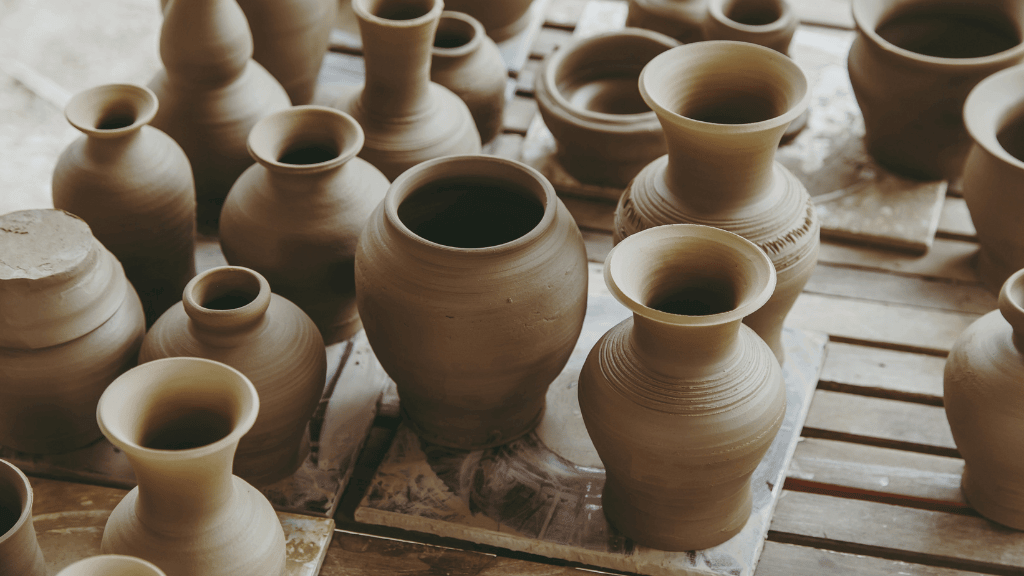
Bisque firing is the first kiln firing in most pottery, the one that turns dried clay into hard, porous ceramic called bisqueware. It usually runs between cone 08 and cone 04, roughly 1,728°F to 1,945°F (942°C to 1,063°C), and the change it makes is permanent.
That first firing does three jobs: it drives the chemical water out of the clay, it leaves the surface porous so glaze can soak in, and it makes the piece strong enough to handle while you glaze it. After bisque, the clay can never go back to workable mud.
What Bisque Firing Does to the Clay
Dried clay looks finished, but on a molecular level it’s still holding water. Bisque firing burns that off for good and rearranges the clay into ceramic. Here’s what happens as the temperature climbs:
- Water smoking (up to about 660°F / 350°C). Any leftover physical water escapes as steam. This is the slow, careful part of the firing.
- Burnout (around 570°F to 1,470°F / 300°C to 800°C). Organic material, carbon, and sulfur in the clay burn away. Getting these out now matters, because if they escape during the glaze firing instead, the gases bubble up through molten glaze and leave defects.
- Dehydroxylation (the same zone). The chemically bonded water leaves the clay molecules. This is the point of no return. Once it happens, the piece is ceramic.
- Quartz inversion (about 1,063°F / 573°C). The silica in the clay shifts crystal structure and the piece expands slightly, then contracts again at the same temperature on the way down.
The result is bisqueware: chalky, lightweight, hard enough to sand and decorate, and porous enough to drink up glaze. For more on the material itself, see what is bisque pottery.
Why Potters Bisque Fire at All
You can glaze raw greenware and fire once, and plenty of production potters do. But the two-firing system is standard in studios because it’s far more forgiving. Bisque firing first gives you:
- Safe glazing. Bisqueware survives dipping, pouring, and brushing. Soak fragile greenware in liquid glaze and it often slumps or cracks.
- Even glaze coverage. The porous bisque surface pulls a consistent layer of glaze into itself, so you get fewer bare patches and crawls.
- A flaw checkpoint. Cracks, warps, and weak joints show up after the bisque, before you spend glaze and a second firing on a doomed piece.
- Clean burnout. Carbon and organics are gone before glaze ever goes on, which means a smoother final surface.
If you’ve ever wondered why your studio runs two separate kiln loads, this is the reason. More on that in can you fire pottery twice.
Bisque Firing Temperature and Cones
Most studios bisque fire somewhere between cone 08 and cone 04. The clay body you’re using nudges where you land, but the bisque range itself is fairly narrow across the board.
| Clay type | Common bisque cone | Approx. temperature |
|---|---|---|
| Earthenware | Cone 06 to 04 | 1,828°F to 1,945°F (998°C to 1,063°C) |
| Stoneware | Cone 08 to 04 | 1,728°F to 1,945°F (942°C to 1,063°C) |
| Porcelain | Cone 08 to 06 | 1,728°F to 1,828°F (942°C to 998°C) |
The two cones you’ll hear most often:
- Cone 06 (about 1,828°F / 998°C). The default in most community studios. Leaves the ware nice and porous for dip glazing.
- Cone 04 (about 1,945°F / 1,063°C). A harder, slightly less porous bisque. Commercial paint-your-own bisque is usually fired here so it sheds dust and ships well.
One counterintuitive note: bisque is normally cooler than the glaze firing for stoneware and porcelain (which go up to cone 5 to 10, roughly 2,167°F to 2,381°F / 1,186°C to 1,305°C), but for low-fire earthenware it’s often hotter than the glaze fire. A cone 04 bisque followed by a cone 06 glaze fire is standard low-fire practice.
Want the bigger picture on kiln temperatures? See how hot a pottery kiln gets.
The Bisque Firing Schedule, Step by Step
A bisque firing isn’t one steady climb. It moves slowly through the danger zones and speeds up once the water is gone. A typical electric kiln schedule looks like this:
- Preheat / candling (optional, 2 to 8 hours). Hold the kiln around 180°F to 200°F (82°C to 93°C) to drive off any last moisture. I candle overnight for thick or hand-built work.
- Slow climb to about 1,100°F (593°C). Roughly 150°F to 200°F per hour. This is where steam release and quartz inversion both happen, so you go gently.
- Faster climb to final temperature. Once the water’s out, the kiln can speed up to its target cone.
- Cooling. The kiln cools naturally for 12 to 24 hours. Don’t crack the lid early.
If your pieces are thick or you suspect they aren’t fully dry, slow the whole thing down and candle longer.
How Long Does a Bisque Firing Take?
A bisque firing usually takes 8 to 12 hours to reach temperature, plus another 12 to 24 hours of cooling before it’s safe to open. From loading to unloading, plan on a full day, often closer to a day and a half.
Bisque is deliberately the slower of the two firings. The kiln spends most of its time low and slow, easing water out without blowing pieces apart. Thick walls, a densely packed kiln, worn elements, and a long overnight candle all stretch the clock further.
For how this fits alongside the glaze firing and the full clay-to-finished timeline, see how long pottery takes to fire.
Greenware vs. Bisqueware vs. Glaze-Fired Ware
Clay passes through three stages, and knowing which one a piece is in tells you what you can safely do with it.
| Stage | What it is | Strength | Watertight? |
|---|---|---|---|
| Greenware (bone dry) | Shaped, dried, unfired clay | Very fragile, chips and snaps | No, dissolves in water |
| Bisqueware | Fired once, unglazed | Hard but porous | No, absorbs water but won’t dissolve |
| Glaze-fired ware | Glazed and fired again | Durable, vitrified surface | Yes, waterproof where glazed |
Here’s the part that trips people up: cone 04 bisque earthenware is still porous. It is not watertight or food safe on its own. A bisqued mug will soak up water and weep right through the wall. The piece only becomes waterproof after it’s glazed and fired a second time. If you want to take bisqueware to a finished, usable piece, start with how to glaze pottery at home.
Why You Can’t Skip Drying First
The single most important rule of bisque firing: the piece must be bone dry before it goes in the kiln. Not air dry, not “dry to the touch,” bone dry all the way through. A bone-dry piece feels room temperature against your cheek. One that still holds moisture feels cool, because the water inside is evaporating. If you can feel that coolness, it’s not ready.
Skipping this step is the classic cause of pieces blowing apart in the kiln. Trapped water turns to steam at 212°F (100°C) and expands hard enough to shatter the piece, sometimes taking neighboring pots with it. Thick walls, sealed forms, and hollow handles are the usual culprits. The full breakdown is in why pottery explodes in the kiln.
Can You Bisque Fire in a Kitchen Oven?
No. A home oven tops out around 500°F (260°C), and bisque firing needs at least 1,728°F (942°C) to convert clay into ceramic. An oven can’t get within a thousand degrees of what’s required.
What an oven can do is gently help dry greenware. Setting damp pieces near a warm oven speeds drying before a real kiln fires them, but that’s drying, not firing. The clay stays greenware until it sees kiln temperatures. Air-dry and oven-bake polymer clays are a separate product: they harden at low heat but they aren’t ceramic and can’t be glaze fired.
Tips for a Clean Bisque Firing
A few habits that have saved me the most heartbreak:
- Candle thick work overnight. Holding low for several hours drives residual moisture out of sculptures and heavy pieces.
- Go slow through the steam zone. Keep the climb gentle until you’re well past 212°F (100°C).
- Stacking is fine, within reason. Bisque pieces can touch and even nest, since there’s no glaze to fuse them. Just don’t crush delicate rims.
- Vent early. Prop the lid or run the vent during the first hours so vapor and burnout gases escape.
FAQ
What is bisque firing?
Bisque firing is the first of two kiln firings in most pottery. It takes bone-dry greenware up to roughly cone 08 to 04 (about 1,728°F to 1,945°F / 942°C to 1,063°C), turning the clay into hard, porous bisqueware that’s ready to glaze. A typical bisque fire takes 8 to 12 hours plus 12 to 24 hours of cooling.
What is bisque ware?
Bisqueware (also called bisque or biscuit ware) is any piece that has been through its first firing but has no glaze on it yet. It’s hard and permanently ceramic, but still porous, which is why glaze soaks into it so evenly.
What is bisque clay?
There’s no special clay called bisque. Any clay body, whether earthenware, stoneware, or porcelain, becomes bisque after its first firing. So “bisque clay” just means whatever clay you used, once it has been bisque fired.
How long does a bisque firing take?
About 8 to 12 hours to reach cone 08 to 04, plus another 12 to 24 hours of cooling. From loading to unloading, plan on roughly a full day. Thick or freshly dried work needs a slower schedule and often an overnight candle.
Can you fire clay in an oven?
No. A kitchen oven maxes out around 500°F (260°C), far below the 1,728°F (942°C) minimum that real bisque firing needs. An oven can help dry greenware faster, but it can’t fire it. Oven-bake polymer clay is a separate product and isn’t true ceramic.
Is bisqueware waterproof or food safe?
No. Bisqueware is porous, so it absorbs water and isn’t food safe on its own. A piece becomes watertight and food safe only after it’s coated with a food-safe glaze and fired a second time. Be cautious with old or imported glazes, since some contain lead and aren’t safe for anything that holds food or drink.