
What Is Delft Pottery?
By Linda · · 8 min read
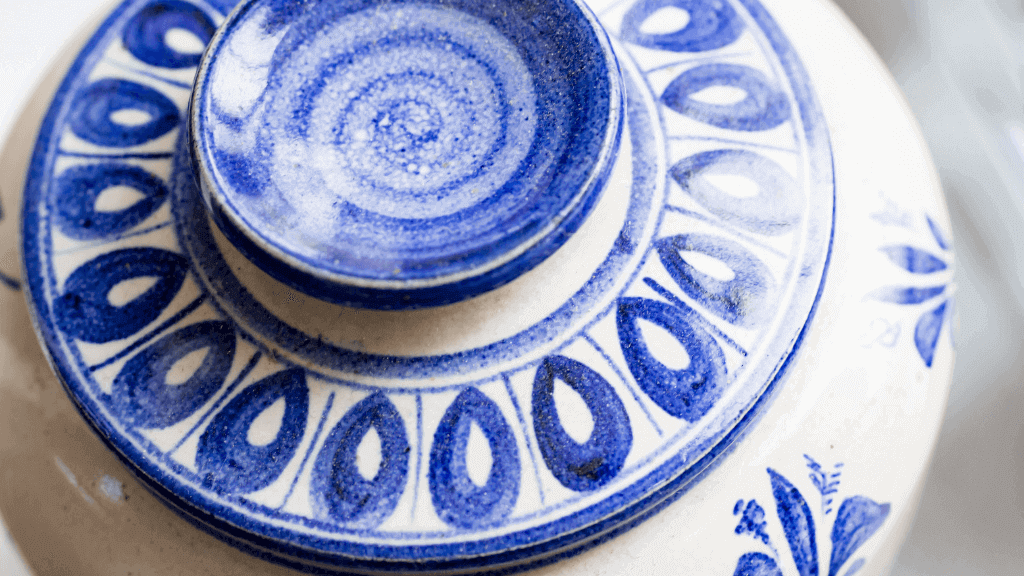
Delft pottery, also known as Delftware or Delft Blue, is a type of tin-glazed earthenware originating from the city of Delft in the Netherlands during the 17th century. You’ll know it by its blue and white designs, often depicting scenes from Dutch life, floral patterns, or historical events. The pottery started out as an affordable alternative to Chinese porcelain and became popular across Europe.
What Does “Delft” Mean?
Delft is the name of a city in South Holland, the Netherlands, located between Rotterdam and The Hague. When people say “Delft” in a pottery context, they mean tin-glazed earthenware made in (or in the style of) that city. The word has become shorthand for the blue-and-white ware itself.
You’ll also see the Dutch terms “Delfts Blauw” (Delft Blue) and “Delftware.” Technically, Delftware is a Dutch branch of the same tin-glaze family that includes faience in France and majolica in Italy and Spain. Same basic technique, different national traditions.
Origins of Delft Pottery
The history of Delft pottery dates back to the 17th century, when the Dutch East India Company began importing Chinese porcelain. Dutch potters admired that thin white ware and set out to make a local, affordable version of it. The result was Delftware, a tin-glazed earthenware that copied the blue and white designs of Chinese pottery.
When political turmoil in China disrupted porcelain imports in the mid-1600s, Delft’s potters stepped into the gap. Dozens of workshops sprang up in the city, many of them in former breweries. That’s why historic Delft factories carry names like “The Greek A” and “The Porcelain Bottle” (De Porceleyne Fles).
Characteristics of Delftware
Delftware has a shiny, tin-glazed surface and is fired at a lower temperature than porcelain, which makes it cheaper to produce but less durable. The blue and white designs, painted with cobalt oxide, often feature traditional Dutch scenes, floral patterns, and chinoiserie motifs borrowed from Chinese porcelain.
Tin-Glazed Earthenware
The key to Delft pottery’s unique appearance is tin-glazed earthenware, a type of pottery in which a tin oxide glaze is applied to an earthenware body. This technique creates a smooth, white surface ideal for intricate hand-painted decorations. Tin glazing was first used in the Middle East and later spread to Europe, where it gained popularity in areas such as Italy and Spain before finally making its way to the Netherlands.
Because the body underneath is reddish or buff earthenware, a chip on a genuine piece reveals dark clay under the white glaze. That’s one of the quickest authenticity checks there is. Porcelain copies are white all the way through.
Iconic Blue and White Designs
The blue and white color scheme used in Delft pottery is a homage to Chinese porcelain. Cobalt oxide is used to create the intense shade of blue, which is paired with the white tin-glazed surface to produce instantly recognizable designs. Over time, Delftware expanded to include polychrome (multi-colored) styles, but the classic blue and white combination remains the most sought after.
How Delft Pottery Is Made
The process of creating authentic Delftware involves multiple steps: preparing the clay, a first firing, applying the tin glaze, hand-painting the designs, and a final glaze firing.
Clay Preparation and Shaping
The clay (traditionally a mixture of local and imported clays) is kneaded to remove air bubbles, then shaped by wheel throwing, molding, or press molding. The formed piece dries for several days before its first (bisque) firing.
Applying Tin Glaze
After the bisque firing, the pottery is coated with a tin oxide glaze. Historically this glaze contained powdered glass, white lead, and tin ash suspended in water. When fired, it forms the white, glossy surface that serves as the canvas for the painted decoration. That lead content is also why antique Delftware belongs on a shelf, not on the dinner table. Old lead glazes can leach into food.
Hand-Painting the Designs
Painters apply the design directly onto the powdery, unfired glaze with cobalt oxide. The raw glaze absorbs the pigment instantly, like ink on blotting paper, so there’s no room for correction — every brushstroke is final. The cobalt looks nearly black when applied and only develops its famous blue in the kiln.
Firing the Pottery
The painted pottery is fired at roughly 1,650 to 1,830°F (900 to 1,000°C) to fuse the tin glaze and permanently fix the blue design. The result is the glossy, uniquely Dutch finish Delftware is known for.
Delftware in the Dutch Golden Age
The Dutch Golden Age in the 17th century was a period of huge artistic and economic growth, and Delft pottery rode that wave. At the industry’s peak, dozens of factories operated in Delft, employing skilled artisans to produce everything from tiles and plates to elaborate tulip vases. Delftware became a symbol of wealth and status across Europe.
Most of those original factories closed by the 19th century as cheaper English creamware and true porcelain took over the market. De Porceleyne Fles (founded in 1653 and known today as Royal Delft) is the only one of the original Golden Age factories still producing.
How to Spot Fake Delft Pottery Marks
This is the question I get most often, and for good reason: the vast majority of “Delft” pieces floating around flea markets and online auctions are mass-produced souvenirs, not hand-painted Dutch Delftware. Here’s how I sort the real from the fake.
What Authentic Marks Look Like
Genuine Delftware from a recognized factory is marked on the bottom, typically hand-painted rather than stamped. A Royal Delft (De Porceleyne Fles) mark, for example, combines a small jar or bottle symbol, the initials “JT,” the word “Delft,” and a letter code indicating the year of production. Other legitimate makers, such as De Delftse Pauw, used their own consistent hand-painted marks. Because they’re painted by hand, authentic marks show slight irregularity. No two are perfectly identical.
Red Flags That Suggest a Fake or Souvenir Piece
- “Made in China,” “Japan,” or “Taiwan” anywhere on the base. Delft-style decoration, maybe, but not Delftware.
- A stamped or printed mark with perfectly uniform lines. Authentic marks are brushed on; printed marks are a machine product.
- The word “Delft” alone with no factory symbol. “Delft” by itself describes a style, not an origin, and has been slapped on wares made in England, Germany, and Asia for over a century.
- “Delft Blue” or “Delfts Blauw” with “Hand painted” in English is common on tourist-shop pieces. Some are decent quality, but they’re modern souvenirs, not antiques.
- Transfer-printed decoration. Look at the blue design under magnification. A fine dot pattern (like a newspaper photo) means it was printed, not painted. Hand-painted work shows brushstrokes, varied line weight, and tiny imperfections.
- A pure white body at any chip or unglazed foot ring. Real Delftware is earthenware, so chips reveal buff or reddish clay.
One dating tip: pieces marked “Made in Holland” in English were produced for export after 1891, when US law began requiring country-of-origin marks on imports. That phrase alone tells you a piece isn’t a 17th- or 18th-century antique.
Authentic vs. Imitation at a Glance
| Feature | Authentic Delftware | Imitation / Souvenir |
|---|---|---|
| Mark | Hand-painted factory mark (e.g., Royal Delft bottle + JT + year letter) | Stamped/printed, or just “Delft” with no factory symbol |
| Decoration | Hand-painted; visible brushstrokes, slight irregularity | Transfer print; uniform lines, dot pattern under magnification |
| Body | Earthenware; buff/red clay visible at chips | Often white porcelain or whiteware throughout |
| Glaze | Tin glaze; soft white, may show fine crazing on antiques | Hard, glassy modern glaze |
| Feel | Relatively light, slightly soft glaze surface | Heavier, very hard surface |
What Is Delft Pottery Worth?
Value depends almost entirely on age, maker, condition, and whether the piece is hand-painted. As a rough guide: mass-produced souvenir pieces typically sell for a few dollars to around $20; modern hand-painted pieces from recognized makers like Royal Delft commonly run from about $50 into the hundreds; and genuine 17th- and 18th-century antique Delftware can bring hundreds to many thousands at auction, depending on rarity and condition.
Condition matters enormously with tin glaze because it chips easily. A hairline crack or rim chip that would barely matter on bone china can cut an antique Delft piece’s value substantially. For anything you suspect is genuinely old, get an appraisal before selling.
Maintenance and Care for Delft Pottery
Tin-glazed earthenware is more fragile than porcelain, so proper care matters.
Cleaning and Handling
Handle Delft pottery with clean, dry hands and support pieces from the base, not by handles or rims. Clean with a soft, damp cloth. Never abrasives, and never the dishwasher. For intricate pieces, a soft-bristle brush gets dust out of crevices without scratching the glaze.
Storage and Display
Display pieces away from direct sunlight and away from temperature swings (not above a radiator or fireplace), since thermal stress can craze or crack the glaze. Use stable shelving, and for plates on stands, make sure the stand grips without pressure on the painted face. Inspect your collection periodically so small problems don’t become big ones.
FAQ: Delft Pottery
What is Delft pottery in simple terms?
Delft pottery is blue-and-white tin-glazed earthenware made in (or in the style of) the Dutch city of Delft, originally created in the 17th century as a cheaper local alternative to imported Chinese porcelain.
How do I identify fake Delft pottery marks?
Check whether the mark is hand-painted (authentic) or stamped/printed (usually a fake or souvenir), look for a recognized factory symbol such as the Royal Delft bottle with “JT” initials, and examine the decoration under magnification. A dot pattern means transfer printing, not hand-painting. “Delft” alone, or any “Made in China/Japan” stamp, indicates an imitation.
Is Delft pottery the same as porcelain?
No. Delft is tin-glazed earthenware fired at relatively low temperatures, while porcelain is made from kaolin clay fired much hotter, making it harder and translucent. A chipped Delft piece shows dark clay beneath the glaze; porcelain is white throughout.
Is Delft pottery valuable?
It can be. Souvenir pieces are worth a few dollars, modern hand-painted Royal Delft sells from roughly $50 into the hundreds, and authentic antique Delftware from the 1600s–1700s can fetch thousands depending on rarity and condition.
Why is Delft pottery blue and white?
The color scheme imitates the Chinese porcelain that inspired it. Dutch painters used cobalt oxide (one of the few pigments that holds its color reliably through a glaze firing) over a white tin glaze to reproduce that look.
What items is Delftware commonly made into?
Plates, vases, tiles, teapots, tulip vases (pyramid-shaped vases with multiple spouts), and decorative figurines. The most famous example may be the miniature Delft Blue houses given out by KLM airlines.