
What Is Raku Pottery?
By Linda · · 8 min read
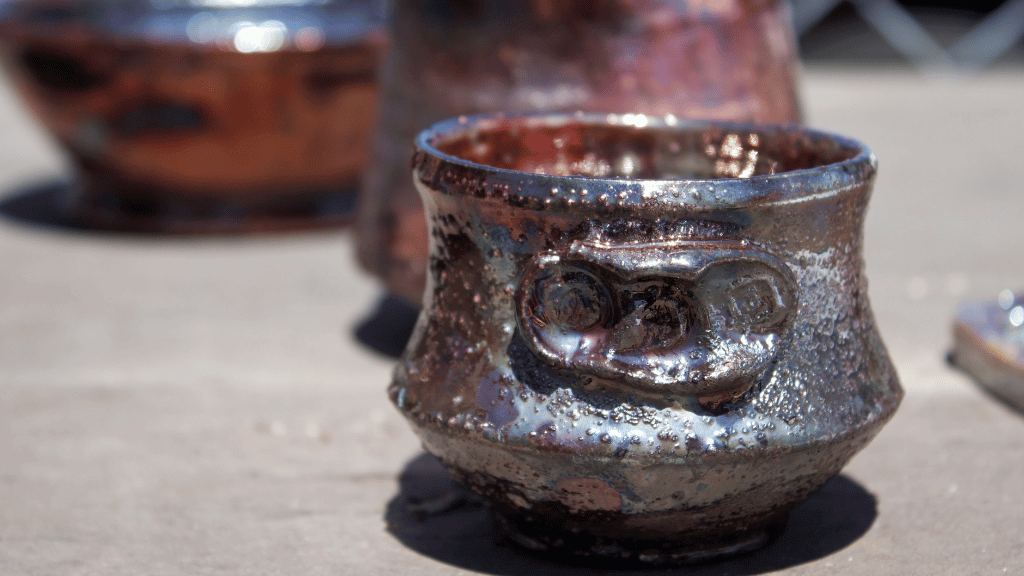
Raku pottery is a Japanese ceramic technique in which glazed pieces are fired quickly to around 1,600 to 1,800°F (870 to 980°C), pulled from the kiln while still glowing hot, and placed in a container of combustible material like sawdust or newspaper. The smoke and oxygen-starved atmosphere create crackled glazes, metallic flashes, and carbon-black surfaces that can’t be exactly repeated.
That unpredictability is the whole point. No two raku pieces come out the same, which is why the technique has stayed popular for more than 400 years.
The Meaning of “Raku”
The word raku (楽) translates roughly to “ease,” “enjoyment,” or “comfort” in Japanese. The name traces back to 16th century Kyoto, where the ruler Toyotomi Hideyoshi granted a seal bearing the character to the family of the potter Chojiro, whose hand-built tea bowls defined the style.
The Raku name became a hereditary title, and the Raku family has continued making tea ware in Kyoto for over fifteen generations. So “raku” refers to three related things: a family of potters, a traditional Japanese style of tea ceremony ware, and (in the West) a fast-fire technique with post-firing reduction, inspired by the original.
Japanese Raku: Origins and the Tea Ceremony
Traditional Japanese raku began in Kyoto in the 1580s. Chojiro, working under the influence of the tea master Sen no Rikyū, created simple, hand-formed tea bowls (chawan) that rejected the ornate Chinese ceramics fashionable at the time.
These bowls embodied wabi-sabi, the appreciation of imperfection, simplicity, and natural materials. A few traits define classic Japanese raku:
- Hand-built, never wheel-thrown. Bowls are shaped by hand and carved with a knife, so each carries the maker’s touch.
- Two main glaze traditions. Black raku (kuro-raku) wears a deep, stony black glaze; red raku (aka-raku) shows a soft reddish clay body under a thin clear glaze.
- Quiet, subdued surfaces. Traditional pieces avoid flashy color. The beauty is in the form, the weight in the hand, and the way the bowl holds tea.
In a tea ceremony, the bowl is meant to be cradled in both hands, so raku bowls are made slightly irregular and warm to the touch. That intimacy is why raku and the tea ceremony are still linked today.
Western Raku: How the Technique Changed
What most American and European potters call “raku” is a mid-20th century adaptation. The American potter Paul Soldner popularized the post-firing reduction step: pulling red-hot pots from the kiln and smothering them in combustibles. That step is not part of the traditional Japanese process.
Western raku embraces wheel-thrown forms, bright copper and metallic glazes, dramatic crackle patterns, and large sculptural work. It kept the speed and spontaneity of Japanese raku but turned the visual style up considerably.
| Traditional Japanese Raku | Western Raku | |
|---|---|---|
| Origin | Kyoto, 1580s | United States, mid-1900s |
| Forming | Hand-built tea bowls | Wheel-thrown or hand-built, any form |
| Glazes | Subdued black or red | Bright metallics, copper lusters, crackle whites |
| Cooling | Removed hot, air-cooled | Post-firing reduction in sawdust or paper |
| Purpose | Tea ceremony ware | Decorative and sculptural work |
The Raku Firing Process, Step by Step
Stage 1: Shaping and Bisque Firing
The piece is shaped by hand or on the wheel using a coarse, grogged clay body that can survive thermal shock. Once bone dry, it gets a standard bisque firing to harden it for glazing, usually cone 06 to 04, about 1,828 to 1,945°F (998 to 1,063°C).
Stage 2: Glazing and Decorating
After cooling, the pot is coated with raku glazes, which are formulated to melt at low temperatures and are often loaded with metal oxides like copper carbonate. Wax resist, slips, and partial glazing all work here. Any bare clay turns smoky black during reduction, and potters use that on purpose for contrast.
Stage 3: The Raku Firing
The glazed pottery goes into a raku kiln (usually a small propane-fired one) and comes up fast to roughly 1,600 to 1,800°F (870 to 980°C). The whole firing takes 30 minutes to 2 hours, compared with the 8 to 12 hours of a typical glaze firing. The potter watches through a peephole until the glaze looks glossy and molten.
Stage 4: Post-Firing Reduction
Using long tongs and wearing heat-resistant gloves and a face shield, the potter lifts the glowing piece out of the kiln and sets it in a metal can filled with sawdust, dry leaves, or shredded newspaper. The material ignites instantly, the lid goes on, and the trapped smoke starves the surface of oxygen.
This reduction atmosphere is what creates raku’s signature effects: copper glazes flash to metallic rainbow lusters, crackle glazes pull carbon into their cracks as dark spiderweb lines, and unglazed clay turns matte black. Reduction typically runs 10 to 30 minutes.
Stage 5: Cooling and Cleaning
The piece is pulled from the can, often quenched in water to halt the chemistry, then scrubbed with an abrasive pad to remove ash and soot. Only then does the final surface appear, and it’s always a surprise. I’ve been doing this for years and I still hold my breath at this step.
What Makes Raku Pottery Distinctive
A few qualities show up again and again in raku work:
- Crackle glaze. The rapid cooling makes the glaze contract faster than the clay, producing a fine network of cracks that the smoke stains dark.
- Metallic and iridescent flashes. Copper-bearing glazes can shift from turquoise to gold, bronze, and oil-slick rainbow depending on how reduction goes.
- Carbon-black clay. Any unglazed surface absorbs carbon and turns velvety black.
- One-of-a-kind results. The same glaze on two identical pots can come out completely different. Potters control the variables, but the fire gets the final vote.
That last point is why I tell students not to get too attached to any single piece before a raku firing. You’ll lose some to cracking, and others will come out better than anything you planned.
Is Raku Pottery Food Safe?
No. Raku is fired at low temperatures, so the clay never vitrifies. It stays porous and will absorb liquids. The crazed glaze surface harbors bacteria, and many raku glazes contain metals you don’t want near food. Treat raku as decorative work only: no food, no drinks, and no water for fresh flowers (use a sealed liner inside a raku vase if you must). I cover the details in is raku pottery food safe.
This porosity also makes raku more fragile than stoneware or porcelain. To clean a piece, dust it with a soft dry cloth. Never submerge it in water.
Variations on the Raku Technique
Once potters started experimenting with post-firing effects, several offshoots emerged:
- Horse hair raku: strands of horse hair (or feathers) are draped on the bare, hot pot, where they burn and leave wavy carbon lines.
- Naked raku: a sacrificial slip-and-glaze layer is applied, fired, and then flaked off after reduction, leaving smoke patterns on bare clay.
- Obvara: an Eastern European cousin where the hot pot is dipped in a fermented flour mixture, producing mottled tan-and-brown surfaces.
- Saggar firing: pieces are enclosed with combustibles, salts, and oxides inside a container during the firing itself for similar smoky effects.
Trying Raku Yourself: Cost and What to Expect
Raku is genuinely beginner-friendly to experience, but it’s not something to attempt alone at home without guidance. You’re handling pottery at over 1,500°F in open air.
The best entry point is a raku workshop at a local studio. Expect to pay roughly $50 to $150 for a session where you glaze pre-made bisqueware and fire it the same day. It’s one of the few firing methods where you see results in an hour instead of waiting a week, which is why raku nights are so popular.
If you get hooked and want your own setup, a small propane raku kiln can be built or bought for a few hundred dollars, far less than most electric kilns. Budget for tongs, gloves, a face shield, and metal reduction cans too. Always fire outdoors with good ventilation and keep a hose nearby.
FAQs About Raku Pottery
What is raku pottery in simple terms?
Raku is pottery that’s fired fast at low temperature, removed from the kiln while red hot, and smoked in a container of burning material. The process produces crackled, metallic, and smoky black surfaces that are unique to each piece.
What does the word raku mean?
Raku (楽) means “ease,” “enjoyment,” or “comfort” in Japanese. The name comes from a seal granted to the Kyoto family of potters who originated the style in the 1580s, and the Raku family still makes tea ware today.
What is the difference between Japanese raku and Western raku?
Japanese raku is hand-built tea ceremony ware with quiet black or red glazes, air-cooled after firing. Western raku, developed in the mid-1900s, adds the post-firing reduction step in sawdust or paper and favors bright metallic glazes and crackle effects on wheel-thrown and sculptural forms.
What temperature is raku fired at?
Raku glaze firings reach about 1,600 to 1,800°F (870 to 980°C), roughly cone 010 to cone 06. That’s well below stoneware temperatures, which is why raku pieces stay porous. The bisque firing beforehand is a standard cone 06 to 04 firing.
Can raku pottery hold water or be used for food?
No. Raku clay is porous and the crazed glaze isn’t sanitary, so it will weep water and can’t be used for food or drink. Keep raku decorative, or place a sealed glass liner inside if you want to use a raku vessel for fresh flowers.
What type of clay is best for raku?
A heavily grogged stoneware or dedicated raku clay body works best. The grog (pre-fired clay particles) gives the piece the thermal shock resistance it needs to survive going from 1,800°F to open air without cracking. Smooth porcelain bodies usually fail in raku.