
How To Center Clay on a Pottery Wheel
By Linda · · 9 min read
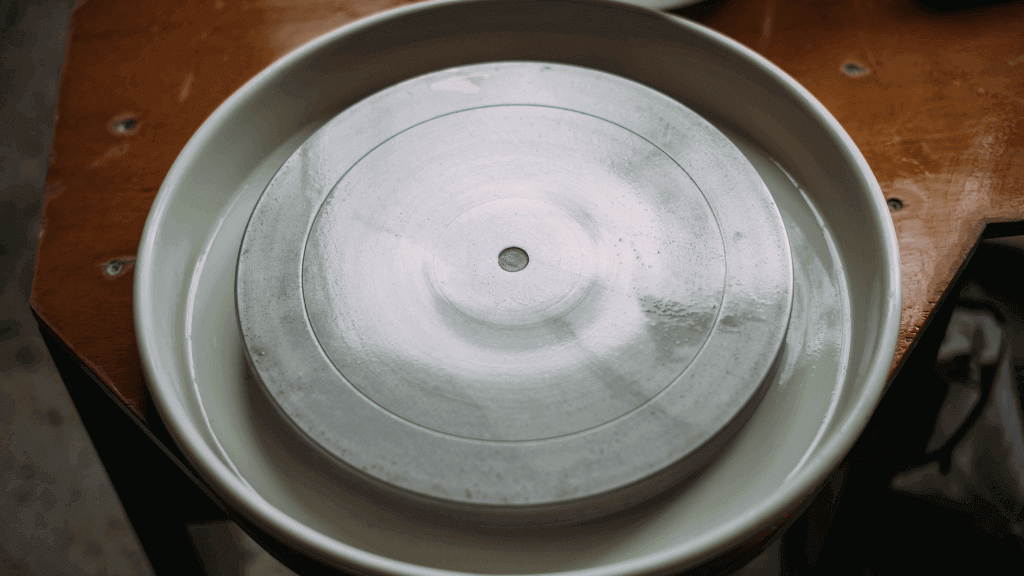
To center clay on a pottery wheel, slap a ball of wedged clay onto the middle of a clean, damp wheel head, set the wheel to a fast speed, wet your hands, and brace your elbows against your thighs. Press the clay inward and slightly down with steady, equal pressure from both hands, holding still and letting the wheel do the work. Cone the clay up into a tall column, then press it back down two or three times. When the clay spins without any visible or felt wobble, it’s centered.
Most beginners take a few weeks of regular practice to center reliably. The good news: centering is almost entirely about body position and steadiness, not strength. Once your setup is right, the clay practically centers itself.
Why Centering Matters
Everything you throw starts from centered clay. If the clay is even slightly off-center, the walls of your pot will be uneven in thickness, the rim will wobble, and the piece will usually twist or collapse as you pull it taller.
Spending an extra minute getting the clay truly centered saves you ten minutes of fighting a lopsided pot. I tell every student the same thing: don’t open the clay until you’d bet money it’s centered.
Preparing the Clay and Wheel Head
Before placing the clay on the wheel, wedge it to remove air bubbles and achieve a consistent texture. Air pockets make the clay lump and jump under your hands no matter how good your technique is. A soft, well-wedged stoneware clay is the most forgiving choice while you’re learning.
Pat the clay into a smooth, round ball with no deep creases. Clean the wheel head, dampen it slightly, and slap the ball down as close to the center as you can. A ball that lands an inch off is a much harder fight. Press it down firmly around the base so it’s sealed to the wheel head and won’t fly off at speed.
How Much Clay Should You Start With?
Start with 1 to 2 pounds (450 to 900 g). Less than a pound is fiddly and hard to feel; more than 3 pounds takes real arm strength to move. One pound of clay throws a nice mug or small bowl, which is plenty for practice. See my list of what to make on a pottery wheel for beginner-friendly first projects.
Wheel Speed and Body Position
Center at a fast wheel speed, roughly two-thirds to full throttle on most wheels. That works out to somewhere around 150 to 240 RPM. This surprises beginners, but a faster wheel means the clay passes under your hands more times per second, so your steady pressure gets applied more evenly. If you’re curious about the numbers, I break down typical speeds in how fast a pottery wheel spins.
Sit close to the wheel, almost hugging it, with your feet flat for stability. Your forearms or elbows should anchor against your thighs or the edge of the splash pan so your hands can’t drift. If you’re hunching or reaching, your seat is probably the wrong height; a properly set up wheel puts the wheel head around lap height so you can lean over the clay and use your body weight instead of arm muscle.
Hand Positioning for Right-Handed Potters
Place your left-hand palm-side down on the clay, fingers pointing 12 o’clock (away from your body). Position your right hand on the right side of the clay, with the fingers and thumb tips pointing inward. The inside of your right wrist should lay against your right thigh.
Hand Positioning for Left-Handed Potters
Put your right hand on the clay, palm-side down, with fingers pointing 12 o’clock (away from your body). Your left hand should be on the left side of the clay, with the fingers and thumb tips pointing inward. Rest the inside of your left wrist against your left thigh.
Centering the Clay: Step by Step
- Wet your hands and the clay. Re-wet whenever you feel drag. Friction is the enemy.
- Bring the wheel up to speed before your hands touch the clay.
- Lock your braced hands onto the clay and press inward and slightly down. Don’t chase the clay. Hold your hands still and let the spinning clay conform to them.
- Hold that pressure for several full rotations. You should feel the wobble shrinking under your palms.
- Release slowly, over two or three rotations. A sudden release knocks the clay right back off-center. This one mistake undoes more centering than anything else.
The key mental shift: your hands are a fixed wall, and the wheel pushes the clay into that wall. The moment you start reacting to every bump, you’re following the wobble instead of removing it.
Coning Up and Down
Once the clay is roughly centered, squeeze it between both palms and let it rise into a tall cone, about twice its starting height. Then place one hand on top, the other supporting the side, and press it back down into a low, wide hockey-puck shape.
Repeat this cone-up, cone-down cycle two or three times. Coning aligns the clay particles in a spiral, evens out moisture, and works out small density differences. Think of it as wedging on the wheel. It makes the final centering far easier.
How Do You Know When the Clay Is Centered?
Test it before you open. With the wheel spinning, rest a fingertip lightly against the side of the clay or hold a fingernail just touching the top edge. If your finger rides smoothly with no tapping, bumping, or visible gap opening and closing, the clay is centered.
You can also simply watch the silhouette: centered clay looks motionless even at full speed, like it’s standing still. Any shimmy or pulse in the outline means it needs another press. The clay should also feel quiet under your palms, with no resistance kicking back at you once per rotation.
Troubleshooting Common Centering Problems
The Clay Wobbles No Matter How Long You Press
Nine times out of ten this is a release problem, not a pressure problem. Count three slow rotations as you ease your hands off. If it still wobbles, check that your elbows are truly braced. Hovering arms transmit every tremor straight into the clay.
The Clay Keeps Pushing Your Hands Around
Your wheel is probably too slow, or the clay is too stiff. Speed up, and if the clay feels like cold butter, wedge in a wetter batch or let it sit wrapped with a damp towel for a few hours. You should be able to dent the ball easily with a thumb.
Your Hands Stick and Drag
Add water more often than feels necessary. Every 5 to 10 seconds while you’re pressing is normal. A sponge held in your outside hand can meter water onto the clay as you work.
The Clay Mushrooms or Folds Over
You’re pressing down too hard relative to your inward pressure, and the top is flaring out over your hand. Folded-over clay traps water and air, so cone it up fully to erase the fold, then press down with your top palm slightly cupped over the edge.
The Clay Tears Off the Wheel Head
The wheel head was too wet or too dry, or the ball wasn’t pressed down firmly. The wheel head should be just barely damp — a slick puddle acts like a slip-and-slide. Score nothing; just slap the ball down hard and seal the bottom edge with a finger before you start.
The Clay Goes Off-Center Later, While Throwing
Uneven pressure during opening or pulling is usually to blame. Slow the wheel down, steady a fingertip against the rim, and gently press the high side back true over several rotations. If a wall has already gone badly uneven, it’s faster to cut the clay off, re-wedge, and start again than to rescue it.
Alternative Centering Methods
The braced two-hand technique above is the standard, but a couple of variations are worth knowing.
| Method | How It Works | Best For |
|---|---|---|
| Braced two-hand (standard) | Heel of one hand on the side, other palm on top, elbows locked to thighs | Most potters, most clay amounts |
| Two-handed vertical | Both hands vertical on either side of the clay, squeezing toward center | Potters with smaller hands; tall starting balls |
| Coning-dominant | Repeated aggressive cone-up/cone-down cycles with minimal static pressing | Stiff clay; large amounts (5+ lbs) |
| Off-the-hump | Center only the top portion of a large mound, throw, cut off, repeat | Production throwing of small pieces |
Experiment until one clicks. Centering is one of those skills where the “right” technique is the one your body repeats consistently. And if the wheel itself is the bottleneck, remember you can practice plenty of clay skills with handbuilding methods that need no wheel at all.
Frequently Asked Questions
Why is centering clay so hard for beginners?
Because instinct works against you. Beginners chase the wobble with their hands instead of holding still, release too fast, and center at too slow a speed. Fix those three habits (braced arms, fast wheel, slow release) and most people see a breakthrough within a few sessions.
How long does it take to learn to center clay?
Expect a few weeks of regular practice to center 1 to 2 pounds reliably, and a couple of months before it feels automatic. Practicing in short, frequent sessions beats one long weekly marathon. Muscle memory is doing most of the learning.
Can you center clay without a wheel spinning fast?
You can, but it’s harder. A slow wheel means fewer rotations under your hands per second, so every small inconsistency in your pressure shows up in the clay. Center fast, then slow the wheel down for opening and pulling.
Is there a specific type of clay best for learning to center?
A smooth or lightly grogged stoneware in a soft state is ideal. It’s plastic and forgiving, and it won’t sand your hands raw. Earthenware works well too. Avoid heavily grogged sculpture bodies and porcelain at first; porcelain in particular punishes every centering error.
How can I prevent my hands from slipping while centering clay?
Keep your hands and the clay lubricated with water, re-wetting every few seconds while you’re actively pressing. A sponge in your outside hand helps meter water and improves grip. Just don’t flood the clay. A soaked surface turns to slip and the clay gets too soft to hold its shape.
How do I know if my clay is properly wedged?
Cut the ball in half with a wire and look at the faces: properly wedged clay shows a uniform, smooth surface with no air pockets, streaks, or hard lumps. It should feel like one consistent texture throughout when you press it. Wedging also aligns the clay particles, which makes centering noticeably easier.