
Can You Use Air Dry Clay On A Pottery Wheel?
By Linda · · 7 min read
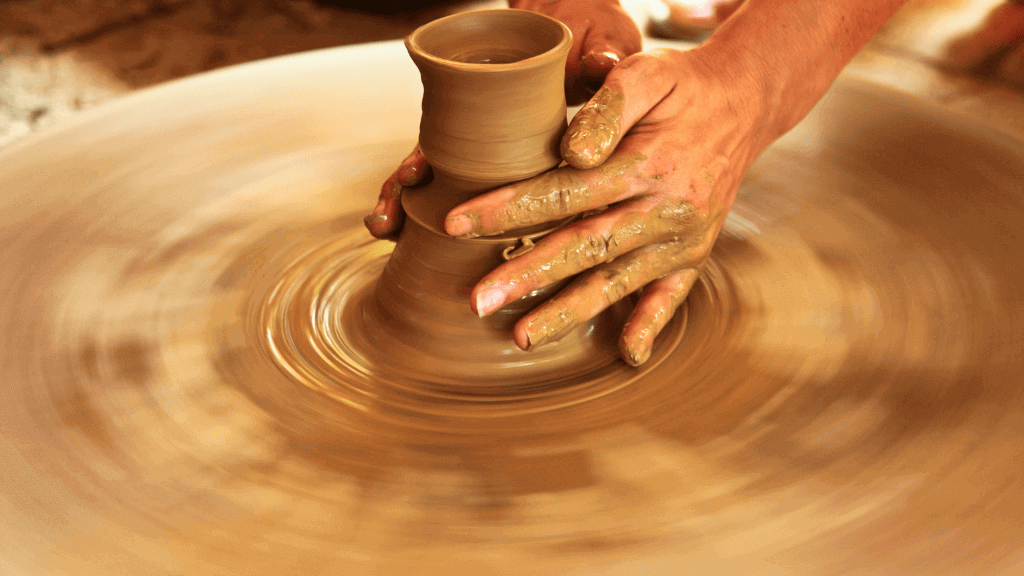
Yes, you can throw air dry clay on a pottery wheel, but only certain types work well. Earthenware-style air dry clays (the kind that feel and smell like real clay) center and throw much like regular pottery clay. Paper-based and polymer-style air dry clays tear, slump, and stick to your hands, so I don’t recommend putting them anywhere near a wheel head.
The bigger trade-off is durability. Anything you throw from air dry clay will never be kiln-fired, so it stays porous and fragile. It is fine for decorative pieces, but it will never hold water or survive daily use the way fired stoneware does.
Which Air Dry Clays Work on a Wheel (and Which Don’t)
Air dry clay is not one material. The label covers at least three very different products, and only one of them throws well.
- Earthenware-based air dry clay. Real clay minerals with added fibers or hardeners so it cures without firing. This is the only type I’d throw. It feels like soft earthenware and responds to water the same way.
- Paper clay / pulp-based clay. Lightweight, spongy, and full of cellulose fiber. It shreds when you try to pull a wall and turns to mush when you add throwing water. Hand-building only.
- Polymer-style or resin-based “clay.” These aren’t clay at all. They don’t slake down with water, they grab your hands instead of sliding through them, and they can gum up your wheel head and splash pan.
Check the package: if it says “natural clay” or “earthenware” in the ingredients, you have a candidate. If it lists paper pulp, resin, or polymers, keep it on the table for hand-building projects instead.
How Air Dry Clay Differs From Regular Throwing Clay
Even the good earthenware-style air dry clays behave differently on the wheel than a standard stoneware body. Here’s what changes.
| Air dry clay | Traditional pottery clay | |
|---|---|---|
| Hardening | Cures in open air, 24–72 hours | Kiln-fired, typically cone 06–10 (1,830–2,345°F / 999–1,285°C) |
| Strength | Brittle; chips and snaps | Vitrified, hard, durable |
| Waterproof | No, must be sealed, still not food-safe | Yes, when glazed and fired properly |
| Forgiveness on the wheel | Low (gets soggy fast) | High (tolerates lots of water) |
| Re-wedging scraps | Usually possible before curing | Always possible before firing |
| Cost | Roughly $8–20 for a small tub | Roughly $15–30 for a 25 lb bag |
The water issue is the one that catches people off guard. Air dry clay is formulated to lose moisture, so when you flood it with throwing water it absorbs it unevenly and slumps. Throw with a damp sponge rather than a wet one, and work fast.
How to Throw Air Dry Clay: Step by Step
If you want to try it, here’s the process I’d follow. It’s the same basic sequence as regular throwing. If you’re new to that, my guide on how to center clay on a pottery wheel covers the fundamentals.
- Knead it thoroughly. Air dry clay straight from the tub is often stiff on the outside and soft in the middle. Wedge or knead for 3–5 minutes until it’s an even consistency with no air pockets.
- Start small. Use a fist-sized ball, about 1 lb (450 g). Air dry clay doesn’t have the strength to hold tall walls, so small bowls and shallow dishes are realistic; mugs and vases mostly aren’t.
- Use minimal water. Wet your hands and sponge lightly. If the surface turns slimy and your fingers start dragging through it, stop adding water.
- Keep the wheel slow. Center at a moderate speed, then throttle down for pulling. High speed flings water into the clay and tears the soft walls. (For reference on speeds, see how fast a pottery wheel spins.)
- Pull thick walls. Aim for walls around 1/4 inch (6 mm) or more. Thin air dry clay walls crack as they cure because the outside dries faster than the inside.
- Wire off and dry slowly. Cut the piece off the bat, let it firm up, then dry it under loose plastic for the first day. Slow, even drying is your best defense against cracks.
- Clean up immediately. Scrape the wheel head and splash pan before scraps harden. Cured air dry clay does not slake back down the way greenware does.
What Goes Wrong (and How to Avoid It)
These are the failures I see most often when people throw air dry clay:
- Collapse mid-throw. Too much water. The clay turns to porridge and slumps over your hand. Use less water and shorter throwing sessions.
- Cracking during the cure. Walls of uneven thickness or fast drying near a heater or sunny window. Dry pieces slowly, away from drafts, and flip them once or twice so the base dries too.
- Surface crazing. Fine cracks from overworking the surface. Smooth once with a rib and leave it alone.
- Attachments popping off. Handles and add-ons need to be applied while both parts are the same dampness, with scored and slipped joints. Same rule as regular clay, just less forgiveness.
Hairline cracks in a cured piece can be patched with a slurry of the same clay, but big cracks usually mean starting over.
Can You Fire Air Dry Clay in a Kiln?
No, and this matters if you’re tempted to “upgrade” a thrown air dry piece later. Most air dry clays contain fibers, glues, or polymer binders that burn out, smoke, or melt in a kiln. At best the piece comes out weak and pitted; at worst it damages the kiln shelf or other work loaded with it.
If your real goal is functional pottery without buying a kiln, you have better routes: community studios fire work for a small per-piece fee, and there are traditional approaches covered in my post on how to fire pottery without a kiln. Air dry clay is the convenience option, not the kiln substitute.
Sealing and Finishing Air Dry Clay Pieces
Cured air dry clay is porous, so every piece needs sealing or it will soften and grow mold the first time it meets moisture.
- Paint first with acrylics once the piece is bone dry (usually 24–72 hours depending on thickness and humidity).
- Seal with 2–3 coats of acrylic sealer, water-based polyurethane, or a clear varnish, letting each coat dry fully.
- Seal the bottom too. The base wicks moisture off countertops and is the spot most people miss.
Even sealed, air dry clay is decorative only: no food contact, no holding water long-term, no dishwasher. If you want glossy, glass-like surfaces, real glaze needs a kiln firing. Sealants are the air dry equivalent.
Is It Worth It? My Honest Take
Throwing air dry clay makes sense in exactly one situation: you already own a wheel, you want decorative pieces, and you have no kiln access. It’s also a low-stakes way to practice centering and pulling without paying for firing.
For everyone else, I’d flip the equation. If you have wheel money but no kiln, buy regular clay and pay a local studio to fire your work. Wheels range from about $200 for tabletop models to $1,500+ for studio machines, and per-piece firing fees are usually just a few dollars. If you have air dry clay but no wheel, skip the wheel entirely and hand-build. That’s what the material is designed for, and the results are better. Once you’re set up, there’s no shortage of project ideas for the wheel.
FAQ
Can you use air dry clay on a pottery wheel?
Yes, earthenware-based air dry clays can be thrown on a wheel using less water, slower speeds, and thicker walls than usual. Paper-based and polymer-style air dry clays cannot. They tear and slump as soon as you try to pull a wall.
What is the best air dry clay for a pottery wheel?
Look for an air dry clay labeled as natural or earthenware clay rather than paper pulp or polymer. The closer the ingredient list is to real clay minerals, the better it will center and throw.
Do you need to seal air dry clay after throwing it?
Yes, always. Cured air dry clay is porous and will soften if it gets wet. Apply 2–3 coats of acrylic sealer or water-based polyurethane on every surface, including the bottom.
Can air dry clay hold water after being thrown on the wheel?
Not reliably. Even well-sealed pieces should be treated as decorative. Use a glass or plastic liner if you want to put fresh flowers in an air dry clay vase.
Will air dry clay ruin a pottery wheel?
No, as long as you clean up before the scraps cure. Wipe down the wheel head and splash pan right after throwing, because hardened air dry clay won’t dissolve in water the way regular clay slop does.