
How Fast Does A Pottery Wheel Spin?
By Linda · · 8 min read
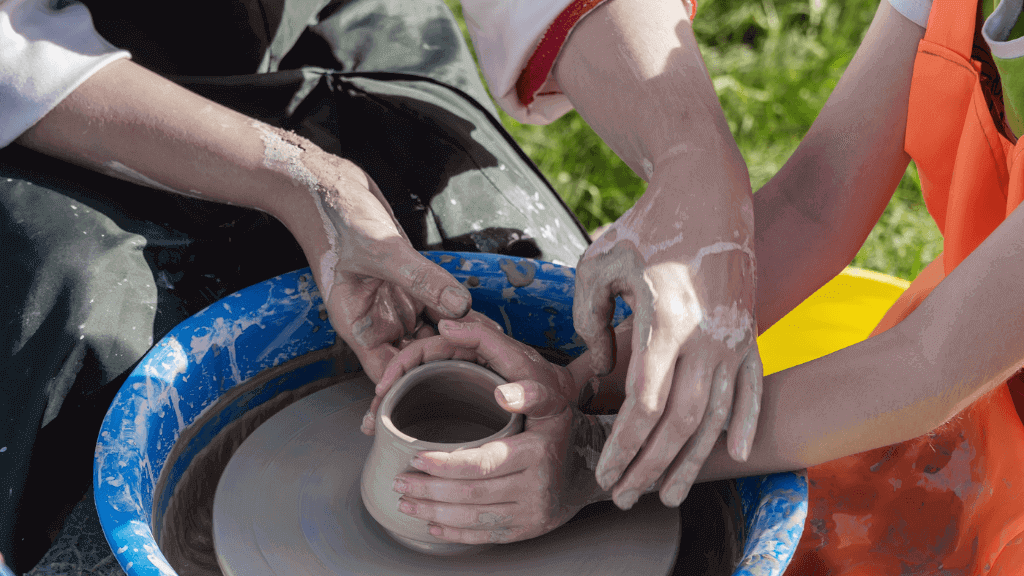
A pottery wheel spins at 0 to about 240–300 RPM (revolutions per minute), and most electric wheels top out around 240–270 RPM. In real throwing, you rarely use the top speed: centering happens at roughly two-thirds to full speed (150–240 RPM), pulling walls at a moderate 100–150 RPM, and finishing rims or trimming details at a slow 30–60 RPM.
So the honest answer is two numbers: the wheel can spin up to about 300 RPM, but the speeds potters use sit between about 30 and 240 RPM depending on the stage of the pot. The foot pedal (or hand lever) gives you the full range, and learning when to slow down matters more than how fast the motor can go.
Pottery Wheel Speed by Throwing Stage
The single biggest beginner mistake I see is throwing the whole pot at one speed. Each stage of throwing wants a different RPM, and the general rule is simple: start fast, finish slow.
| Throwing stage | Typical speed | Why |
|---|---|---|
| Wedged clay slammed on, coning up | 150–240 RPM (fast) | Speed helps the clay move and gives you momentum to center |
| Centering | 150–240 RPM (fast) | The wheel’s rotation does much of the work pressing clay into your hands |
| Opening the form | 100–150 RPM (medium) | Enough speed to keep the clay true, slow enough to control depth |
| Pulling walls | 100–150 RPM (medium) | Faster than this and thin walls twist or flare from centrifugal force |
| Shaping and collaring | 60–100 RPM (slow-medium) | Wide or flared forms wobble and tear at higher speeds |
| Finishing the rim | 30–60 RPM (slow) | One slow pass with a sponge or chamois keeps the rim level |
| Trimming (leather-hard) | 60–120 RPM (medium) | Fast enough for clean tool cuts, slow enough that the pot stays put |
These are guidelines, not laws. A 25 lb (11 kg) lump for a large planter needs a slower centering speed than a 1 lb (0.5 kg) ball for a cup, simply because more mass at speed is harder to control. As your hands get stronger and steadier, you’ll naturally find your own ranges.
If centering is the stage giving you trouble, speed is usually only half the problem. Hand position and bracing matter just as much. I cover that step by step in my guide to how to center clay on a pottery wheel.
Electric Wheels vs. Kick Wheels: Speed Differences
There are two main types of wheel, and they handle speed very differently.
Electric wheels use a motor controlled by a foot pedal, giving you a smooth, continuous range from 0 to roughly 240 RPM (some models reach 300). The speed holds steady no matter how hard you press into the clay, as long as the motor has enough torque for the amount of clay on the wheelhead. This consistency is why nearly all beginners learn on electric wheels today.
Kick wheels are powered by your leg kicking a heavy concrete or steel flywheel. The flywheel stores momentum and gradually slows as friction and the drag of your hands on the clay eat into it, so the speed is always slowly decaying until you kick again. Practical working speeds are similar (fast kicks get you well over 100 RPM), but you can’t hold a perfectly constant speed the way a motor can.
Plenty of experienced potters prefer kick wheels precisely because of that natural deceleration: the wheel slows down as the pot nears completion, which matches the start-fast-finish-slow rhythm of throwing. The trade-off is the physical effort and the sheer mass. Kick wheels routinely weigh 200–400 lb (90–180 kg), which I get into in how heavy is a pottery wheel.
Humans threw on momentum-driven wheels for thousands of years before electricity. The flywheel design goes back to antiquity, and you can read more in my post on when the pottery wheel was invented.
What Happens If the Wheel Spins Too Fast (or Too Slow)?
Too fast, and centrifugal force becomes your enemy:
- Thin walls flare outward or twist off-center during pulls.
- Wide bowls and plates wobble, slump, or tear at the rim.
- Water and slip sling off the pot onto you and the wall behind you.
- Small wobbles amplify. An almost-centered pot at 60 RPM turns into a visibly lurching one at 200 RPM.
Too slow, and the wheel stops doing its share of the work:
- Centering takes far more arm strength because the clay isn’t pressing into your hands often enough per second.
- Pulls come out uneven, since your hands rise faster than the clay completes rotations, leaving spiral ridges.
- Tool marks during trimming look choppy instead of smooth.
My rule of thumb: if you’re fighting the clay, change your speed before you change your technique. Nine times out of ten, beginners who can’t center are going too slow, and beginners who collapse their cylinders are pulling too fast.
Torque Matters More Than Top Speed
When people shop for a wheel, they often fixate on maximum RPM, but almost no one throws at 300 RPM. What separates a cheap wheel from a good one is torque, the motor’s ability to hold its speed under the pressure of your hands and a heavy lump of clay.
A weak motor (under about 1/3 HP) will bog down or stall when you lean into 10+ lb (4.5+ kg) of clay at centering speed. A 1/2 HP or 1 HP wheel keeps spinning at exactly the speed you set, regardless of pressure. That’s why entry-level tabletop wheels are fine for cups and small bowls but frustrate anyone throwing larger work.
Motor power is one of the main things that drives price, alongside wheelhead size and frame quality. If you’re comparing models, my breakdown of how much pottery wheels cost covers what you get at each price level, and buying a used pottery wheel is a sensible way to get a stronger motor for less money.
How to Control Wheel Speed Well
A few habits that make speed control second nature:
- Set up your seating first. If you’re hunched or stretching, your foot can’t modulate the pedal smoothly. Your wheelhead should sit at or slightly below your lap. See how high a pottery wheel should be for the details.
- Change speed between moves, not during them. Adjust the pedal, settle your hands, then make the pull. Changing speed mid-pull is how rims go wavy.
- Slow down before every finishing touch. Rims, handle areas, surface decoration — all of it goes better at 30–60 RPM.
- Practice pedal-only drills. Spend five minutes just holding the wheel at a steady slow speed, then a steady medium speed. It sounds silly; it works.
- Match speed to clay amount. More clay, slightly slower; tiny amounts can take more speed without trouble.
Many modern wheels also let you reverse the rotation direction. Most potters in the West throw counterclockwise with the right hand outside; many Japanese-trained potters throw clockwise. Reversibility is mainly useful for left-handed throwers. It doesn’t change the speeds you use.
Safety at Higher Speeds
Wheel speed is modest compared to power tools, but a spinning wheelhead with 10 lb of wet clay still deserves respect:
- Tie back long hair and remove dangling jewelry, scarves, and loose sleeves. Anything loose can wrap around the wheelhead or get dragged into the clay.
- Keep rings off; clay grabs them and they gouge your work anyway.
- Wipe up slip from the floor around the wheel. Slip on smooth concrete is genuinely slippery, and most studio injuries are falls, not wheel contact.
- Never reach across a spinning wheelhead to grab a tool.
- Stop the wheel completely before removing the bat or the pot.
If wheel work isn’t clicking for you yet, remember the wheel is optional. Handbuilding produces beautiful work too, and I walk through the techniques in can you make pottery without a wheel.
FAQ
How fast does a pottery wheel spin in RPM?
Most electric pottery wheels spin from 0 up to about 240–300 RPM. In practice, potters center at roughly 150–240 RPM, pull walls at 100–150 RPM, and finish details at 30–60 RPM.
What speed should a beginner use on a pottery wheel?
Start centering at about two-thirds of your wheel’s top speed, then drop to roughly half speed for opening and pulling, and go slow (a third of top speed or less) for the rim. Beginners more often err too slow at centering and too fast everywhere else.
Do pottery wheels spin clockwise or counterclockwise?
Both. The Western convention is counterclockwise; the Japanese convention is clockwise. Many electric wheels have a reverse switch so left-handed potters can throw in either direction. Direction doesn’t affect speed.
Is a faster pottery wheel better?
Not really. Almost nobody throws at top speed, so a higher maximum RPM adds little. Motor torque (the wheel’s ability to hold its speed while you press on heavy clay) matters far more than the number on the spec sheet.
How fast does a kick wheel spin compared to an electric wheel?
A well-kicked flywheel reaches comparable working speeds (well over 100 RPM) but gradually slows between kicks instead of holding constant. Electric wheels maintain whatever speed you set with the pedal, which is why they’re easier to learn on.
Why does my pot wobble when the wheel speeds up?
The clay isn’t fully centered. Small off-center errors that are invisible at 60 RPM get amplified at 200 RPM. Slow down, re-center, and check that you’re bracing your arms against your body or the splash pan before speeding back up.