
Can You Fire Pottery In An Oven?
By Linda · · 7 min read
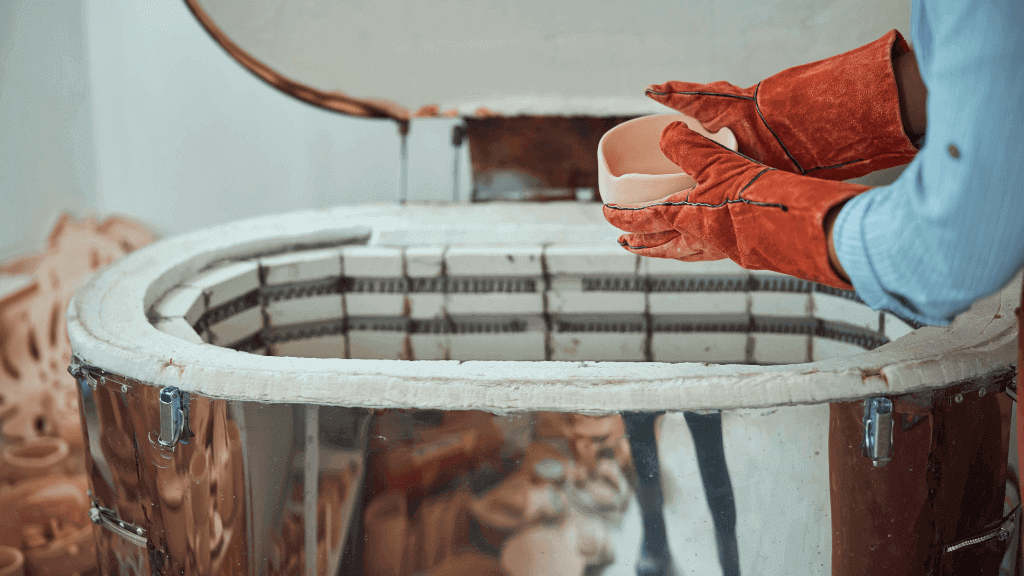
No, you can’t fire pottery in a kitchen oven. Real ceramic firing starts around 1,828°F (998°C) for the lowest-fire clays and runs up to 2,345°F (1,285°C) for stoneware and porcelain, while a home oven tops out around 500–550°F (260–290°C). At oven temperatures, pottery clay never goes through the chemical change (called sintering and vitrification) that turns soft clay into hard, permanent ceramic.
What an oven can do is harden certain clays that were designed for it (polymer clay and so-called “oven-bake” clays), and it can help dry regular clay. Those are useful for decorative projects, but they are not the same thing as fired pottery, and they will never be food-safe or waterproof the way kiln-fired work is.
Why a Kitchen Oven Can’t Fire Clay
Firing isn’t just “getting clay hot.” When clay passes roughly 1,063°F (573°C), the quartz in it changes structure, and as temperatures climb past 1,800°F (982°C), the clay particles begin to fuse together permanently. That fusion is what makes a fired pot ring when you tap it and survive being filled with water.
A kitchen oven falls short by well over 1,000°F (540°C). Here’s the gap in plain numbers:
| Heat Source | Max Temperature | What It Can Do |
|---|---|---|
| Kitchen oven | ~500–550°F (260–290°C) | Cure polymer clay, dry greenware |
| Self-clean oven cycle | ~900°F (480°C) | Still far too cool to fire clay (and you can’t put work inside during the cycle) |
| Low-fire kiln (cone 06–04) | 1,828–1,945°F (998–1,063°C) | Fire earthenware, bisque ware |
| Mid-range kiln (cone 5–6) | 2,167–2,232°F (1,186–1,222°C) | Fire most stoneware |
| High-fire kiln (cone 9–10) | 2,300–2,345°F (1,260–1,285°C) | Fire porcelain and high-fire stoneware |
If you want the full breakdown of those numbers, I’ve written about how hot a kiln needs to be for pottery in more detail.
Clay that’s only been oven-baked is still technically dried clay, not ceramic. Drop it in water for a few hours and it will soften, slake apart, and eventually turn back into mud.
Can “Low Fire” Clay Go in the Oven?
This trips a lot of people up, so let me be direct: “low fire” clay still cannot be fired in a kitchen oven. In pottery, “low fire” means cone 06–04, which is roughly 1,828–1,945°F (998–1,063°C). That’s low compared to stoneware temperatures, but it’s still three to four times hotter than your oven can reach.
When a craft product says “oven-bake clay,” it’s referring to something completely different: polymer clay or a similar formulation designed to cure at 230–275°F (110–135°C). The labels sound similar, but the materials have nothing in common. Low-fire earthenware needs a kiln; oven-bake clay needs only your kitchen oven but will never become true ceramic.
What Really Happens If You Bake Pottery Clay in the Oven
If you put a piece made from regular pottery clay (earthenware, stoneware, or porcelain) into a kitchen oven, here’s the realistic outcome:
- It dries out faster. The oven drives off the remaining moisture, which is the only genuinely useful effect.
- It may crack. Heating clay quickly, especially thick or unevenly built pieces, causes uneven shrinkage and cracks. Trapped moisture turning to steam can pop chunks off the piece. It’s the same reason pottery explodes in the kiln when fired wet.
- It stays fragile. The piece will be bone dry but chalky and weak. It will scratch with a fingernail, crumble at the edges, and dissolve in water.
- It is not food-safe. Unfired clay is porous and can’t be properly glazed, so it harbors bacteria and can’t hold liquids.
Some people do use a barely-warm oven (around 175–200°F / 80–93°C, door cracked open) to speed-dry greenware before kiln firing. That’s fine if you go slowly, but rushing it causes the same cracking problems. Clay that’s too dry or unevenly dried still needs care before it ever sees a kiln.
Clays That ARE Made for the Oven
If your goal is simply “make something at home and harden it without a kiln,” you have two real options:
Polymer clay (brands like Sculpey, Fimo, and Premo) is a PVC-based modeling material, not real clay. It cures at roughly 230–275°F (110–135°C) for 15–30 minutes per 1/4 inch (6 mm) of thickness. Always follow the temperature on the package, because every brand differs slightly. Cured polymer clay is durable for jewelry, figurines, and ornaments, but it’s plastic, not ceramic, and shouldn’t be used for anything that touches food.
Air-dry clay doesn’t need any oven at all. It hardens at room temperature over 24–72 hours. Some makers pop it in a very low oven to speed things up, but high heat will warp or crack it. Like polymer clay, finished air-dry pieces are decorative only and need a sealer (acrylic varnish works) to resist moisture.
A quick comparison:
| Polymer clay | Air-dry clay | Pottery clay (kiln-fired) | |
|---|---|---|---|
| Hardening method | Oven, 230–275°F (110–135°C) | Room temperature | Kiln, 1,828°F+ (998°C+) |
| Waterproof | Mostly, when fully cured | No (needs sealing) | Yes, when glazed |
| Food-safe | No | No | Yes, with food-safe glaze |
| Typical cost | $10–20 per pound | $8–15 for a 2–5 lb tub | $15–25 for a 25 lb bag |
| Best for | Jewelry, miniatures, ornaments | Kids’ crafts, decor | Functional mugs, bowls, plates |
Safety Notes Before You Use Your Kitchen Oven
A few things I’d want you to know before baking any clay at home:
- Don’t overheat polymer clay. Above roughly 350°F (177°C) it can scorch and release irritating fumes (it’s PVC-based). Use an oven thermometer, because many home ovens run 25–50°F hotter than the dial says.
- Ventilate. Crack a window and run the range hood while baking, and let the oven air out afterward.
- Use a dedicated baking surface. Bake clay on a tile, parchment-lined tray, or foil pan you keep for craft use, so residue never touches food.
- Never bake glazes or unknown clays. Pottery glaze does nothing at oven temperatures, and clays not labeled oven-safe can behave unpredictably.
Real Alternatives If You Don’t Have a Kiln
If what you want is real pottery, the kind that holds water and lasts for years, the oven isn’t the answer. But you’re not out of options. I cover this in depth in how to fire pottery without a kiln, but here’s the short list:
- Rent kiln space. Most community studios and many universities fire pieces for a small fee, often $1–3 per pound or a flat per-piece charge. See where you can fire your pottery for how to find one.
- Pit firing or barrel firing. A wood-fueled pit can reach 1,400–1,800°F (760–982°C), which is enough to harden low-fire clay into primitive ceramic. It’s smoky, outdoor-only work, but it’s how pottery was fired for thousands of years.
- Raku or a homemade kiln. A simple DIY pottery kiln built from fire brick or even a converted trash can with a propane burner can hit real firing temperatures.
- Buy a small kiln. Compact tabletop kilns start at a few hundred dollars, and full-size used electric kilns often sell for $300–800. If you’re weighing the investment, my guide to how much a pottery kiln costs walks through the price ranges.
My honest recommendation: if you’re just starting out, use polymer or air-dry clay for fun at home, and rent kiln time for anything you want to keep, use, or sell. Once you’re hooked (and you will be), a small used electric kiln is the upgrade that changes everything.
FAQ
Can you fire clay in a kitchen oven?
No. Kitchen ovens reach about 500–550°F (260–290°C), while real clay needs at least 1,828°F (998°C) to become ceramic. Oven heat will only dry the clay, leaving it fragile and water-soluble.
Can I fire low-fire clay in my oven?
No. “Low fire” still means 1,828–1,945°F (998–1,063°C), far beyond any home oven. Only polymer or “oven-bake” craft clays are designed for oven temperatures.
How do you harden clay in an oven?
Only polymer clay should be hardened in an oven: bake at the package temperature (usually 230–275°F / 110–135°C) for 15–30 minutes per 1/4 inch of thickness on a parchment-lined tray. Regular pottery clay will only dry out, not harden permanently.
Can you fire ceramics in an oven?
No. Ceramics, by definition, require kiln temperatures to form. Anything hardened at oven temperatures is dried clay or cured plastic, not ceramic, and it can’t be glazed or made food-safe.
Is oven-baked clay waterproof or food-safe?
No on both counts. Oven-baked pottery clay dissolves in water, and even properly cured polymer clay is not food-safe. For waterproof, food-safe pottery, the piece must be kiln-fired and coated with a food-safe glaze. See do you need a kiln for pottery for the full picture.