
Can Pottery Be Too Dry To Fire?
By Linda · · 7 min read
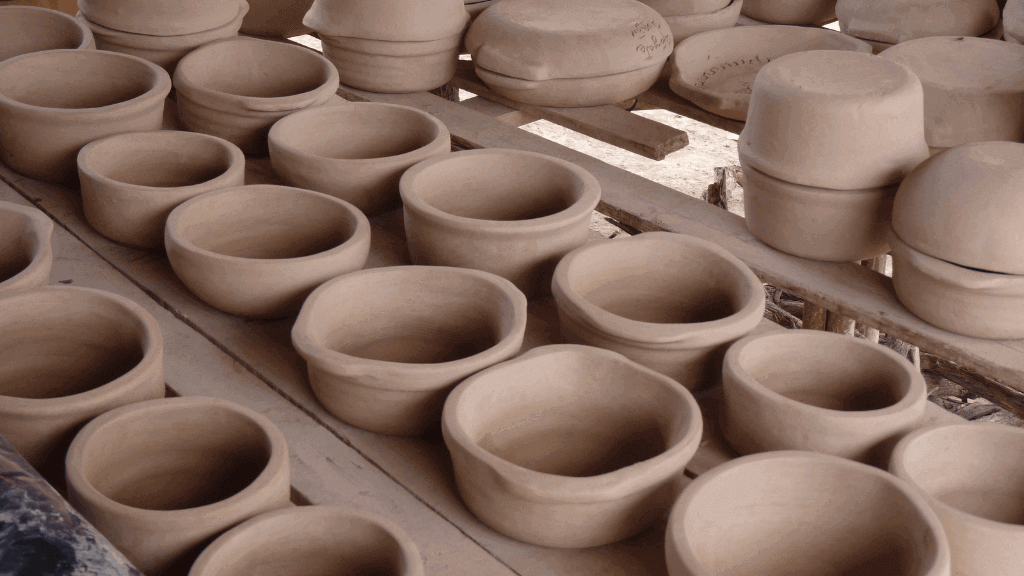
No, pottery can’t be too dry to fire. Bone dry is exactly what you want before a piece goes in the kiln, and greenware that has sat for weeks, months, or even years will fire just fine as long as it stayed dry and intact. The real danger runs the other way: clay that is too wet can crack or explode in the kiln as trapped moisture turns to steam.
What people usually mean when they ask this question is a different problem: clay that dried too fast or too unevenly, which causes cracks and warping before the kiln is ever involved. I’ll cover both. Why dry is good, why fast drying is bad, and what to do with a piece that got away from you.
Why bone dry is the goal, not the problem
Clay holds two kinds of water. Mechanical water sits between the clay particles and evaporates at room temperature as the piece dries. Chemical water is bonded inside the clay molecules and only leaves during firing, around 660–1,470°F (350–800°C).
Bisque firing is designed to drive off that chemical water slowly. What it is not designed to handle is leftover mechanical water. If a piece still feels cool or damp going into the kiln, that water boils at 212°F (100°C), turns to steam, and expands fast. In a thick-walled piece the steam has nowhere to go. That’s the classic reason pottery explodes in the kiln.
So a piece that is “extra dry” is simply a piece that is safe to fire. There is no such thing as over-dry greenware from the kiln’s point of view.
How to tell if pottery is dry enough to fire
Bone-dry clay has a few reliable tells:
- The cheek test. Hold the piece (gently, bone dry is fragile) against your cheek or the inside of your wrist. Damp clay feels cool because water is still evaporating. Bone-dry clay feels room temperature.
- Color. Bone-dry clay is noticeably lighter and more uniform in color than leather-hard clay. Dark, blotchy patches mean moisture is still hiding inside.
- Sound. Tap it lightly. Bone-dry clay gives a higher-pitched ring; damp clay sounds dull.
- Weight. With experience you can feel the difference. Bone dry is surprisingly light.
Thick areas like the base of a mug or the foot of a bowl hold moisture long after the rim feels dry. When in doubt, give it another two or three days. For typical pieces, expect roughly 1–2 weeks from wet to bone dry depending on thickness, humidity, and airflow. I cover the timeline in detail in how long pottery takes to dry.
If you’re stuck with a piece you suspect is still damp, candle it: hold the kiln at around 180–200°F (82–93°C) for several hours, or overnight for thick work, before starting the bisque ramp. Most electric kiln controllers have a preheat setting for exactly this.
The drying stages at a glance
| Stage | How it feels | What you can do | Fire it? |
|---|---|---|---|
| Wet / plastic | Soft, easily shaped | Throw, handbuild, join | No, it will explode |
| Leather hard | Firm, cool, carvable | Trim, carve, attach handles | No, still too wet |
| Bone dry | Room temperature, light, chalky | Light sanding only; very fragile | Yes, this is the target |
| Bisqueware | Hard, porous, rings when tapped | Glaze and refire | Already fired once |
The real problem: drying too fast, not too dry
When a piece dries unevenly, the dry parts shrink while the wet parts don’t. Clay shrinks roughly 4–12% from wet to bone dry depending on the clay body, and that mismatch builds stress that shows up as:
- S-cracks in the bottoms of thrown pots
- Rim cracks where the top dried days ahead of the base
- Cracked joints where handles or attachments dried at a different rate than the body
- Warping, especially on flat pieces like plates and tiles
Porcelain is the worst offender. Its fine particle size makes it shrink the most and crack the easiest. Large or flat pieces are next, because the surface dries far ahead of the deep layers. Grogged stoneware and sculpture bodies are the most forgiving, since the grog (pre-fired ground clay) reduces overall shrinkage.
These drying cracks don’t heal in the kiln. They get worse. If a bone-dry piece already has a visible crack, firing it usually turns a hairline into a split. I’d rather slake it down and start over than waste kiln space, though there are some patch options below. (For cracks that show up after firing, see how to fix cracks in fired pottery.)
How long can greenware sit before firing?
Indefinitely. Bone-dry greenware has no expiration date, and potters fire pieces that have sat on a shelf for years. Three caveats:
- It’s fragile. Bone-dry clay is the weakest state in the whole process. Store pieces where they won’t get bumped, and don’t stack them.
- Keep it dry. A damp garage or basement can let greenware reabsorb moisture from the air. If it’s been sitting somewhere humid, candle the kiln before firing.
- Dust. Long-stored greenware (and bisqueware) collects dust, which can cause glaze defects later. Wipe bisque with a damp sponge before glazing.
Can you rehydrate clay that got too dry to work?
If the piece dried out before you finished it, you have options. But be realistic about which state it’s in.
Leather hard and just past it: mist with water, wrap tightly in plastic with a damp paper towel or rag against the surface, and wait a day or two. The moisture redistributes and you can often keep trimming or attaching.
Bone dry, unfinished: you generally can’t bring a bone-dry piece back to workable plastic clay in one piece. Rewetting it unevenly just causes cracks. The reliable move is slaking: break the piece up, drop the dry chunks into a bucket of water, and let them dissolve into slip over a day or two. Dry clay slakes fast precisely because it’s bone dry. Pour off excess water, spread the slip on a plaster bat or thick canvas until it stiffens, then wedge it back into usable clay. Nothing is wasted.
Bone dry with small flaws: minor blemishes can sometimes be patched with thick slip or “magic water” (water with a little sodium silicate and soda ash) mixed with paper fiber. These repairs are hit-or-miss through a firing: fine for a low-stakes piece, not worth it for anything you care about.
How to dry pottery evenly (so you never face this)
- Slow everything down. Loosely tent the piece with a plastic bag or drape for the first several days. Slower is always safer.
- Dry upside down when the form allows. Rims dry faster than bases; flipping evens that out and helps prevent warping.
- Get air under the piece. Dry on a wire rack, slatted shelf, or drywall scrap so the bottom isn’t sealed against a table.
- Keep it out of sun, drafts, and heat vents. Fans and heaters dry one side faster than the other, and that gradient is what cracks pots. Skip the hair dryer.
- Match thickness while building. Even walls dry evenly. A thick base under thin walls is a crack waiting to happen.
- Compress your bottoms when throwing, and score-and-slip every joint firmly. Most “drying” cracks were built in back at the wet stage.
Once the piece is genuinely bone dry, it’s ready for the kiln. A bisque firing typically takes 8–13 hours plus cooling, and I walk through the full schedule in how long pottery takes to fire. If you don’t have your own kiln yet, here’s where you can fire your pottery.
FAQ
Can clay be too old or too dry to fire?
No. Dry, well-stored greenware fires the same whether it dried last week or three years ago. Age only matters for workable clay — and even rock-hard bagged clay can be slaked down and reclaimed rather than thrown out.
What happens if you fire pottery that isn’t fully dry?
Water trapped in the walls turns to steam at 212°F (100°C) and expands. Thin pieces may just crack; thick pieces can blow apart and damage neighboring pots in the load. If you’re unsure, hold the kiln at 180–200°F (82–93°C) for a few hours first.
How long should pottery dry before firing?
Most pieces need about 1–2 weeks to reach bone dry; thick or large work can take longer, and humid weather slows everything down. Judge by the cheek test and color, not the calendar.
Can you fire greenware that cracked while drying?
You can, but the crack will almost always open wider in the firing. For anything that matters, slake the piece down and remake it. Hairline flaws on low-stakes pieces can be patched with thick slip or paper-clay slip first. Just keep your expectations low.
Does bone-dry clay shrink more in the kiln?
The drying shrinkage is already done by the bone-dry stage, but the clay shrinks again during firing. Total shrinkage from wet to glaze-fired is commonly 10–15% depending on the clay body. See how much pottery shrinks when fired for the breakdown by stage.