
How Long Does Pottery Take To Dry?
By Linda · · 8 min read
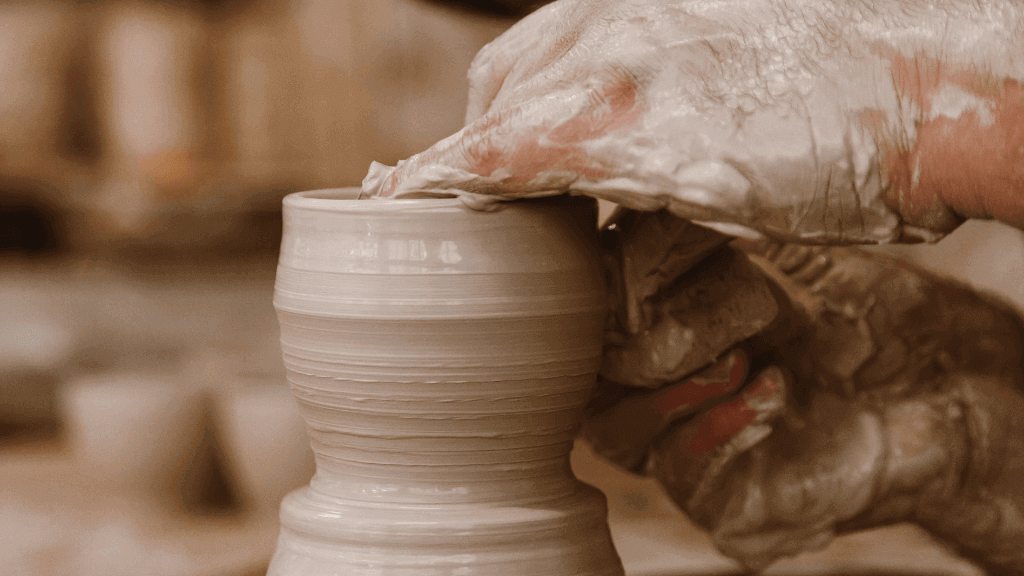
Most pottery takes 1 to 2 weeks to dry completely before it can be fired. A small, thin-walled mug might be bone dry in 3 to 5 days in a warm, dry room, while a thick-walled sculpture or a large platter can take 2 to 3 weeks or longer. Rushing this step is the single most common reason pieces crack or explode in the kiln.
Drying is only the first wait, though. After your piece is bone dry, a bisque firing typically takes 8 to 12 hours plus another 12 to 24 hours of cooling, and a glaze firing runs about the same. From wet clay to finished pot, plan on 3 to 4 weeks total.
The Stages of Drying Clay
Clay doesn’t go from wet to dry in one step. It passes through stages, and knowing them tells you what you can still do to the piece.
- Wet/plastic: Fresh off the wheel or just hand-built. Fully workable.
- Leather hard: Firm like cheddar cheese, cool to the touch. This is when you trim feet, carve, attach handles, and burnish. Usually 1 to 3 days after making.
- Bone dry: The clay turns noticeably lighter in color and feels room temperature against your cheek (damp clay feels cold). All physical water has evaporated. This takes roughly 1 to 2 weeks.
Only bone-dry clay should go into a kiln. Unfired clay at any stage is called greenware, and bone dry is when it’s at its most fragile, so handle it with two hands and don’t pick pieces up by handles or rims.
How to tell if your pottery is bone dry
Hold the piece against your cheek or the inside of your wrist. If it feels cold, there’s still moisture inside and it needs more time. Bone-dry clay feels the same temperature as the room and looks uniformly pale. Any darker patches mean damp spots. When in doubt, give it another two or three days. I’ve never regretted waiting; I have regretted rushing. If you’re unsure whether a piece has sat too long, the good news is that clay can’t really be too dry to fire. Bone dry is exactly what you want.
What Affects Drying Time
Several factors determine whether your piece dries in days or weeks:
- Wall thickness. This is the big one. Water deep inside thick walls has to migrate to the surface before it can evaporate. A piece with half-inch walls takes far longer than one with quarter-inch walls. Keep walls under about 1 inch (2.5 cm) and as even as possible.
- Size and shape. Large flat pieces like platters and tiles dry unevenly (edges dry before centers), and that causes warping. An 8-inch tile should be at least half an inch thick to resist warping, and dried slowly under plastic.
- Humidity. In a humid climate or a damp basement studio, add days or even a week to your estimate. In a dry desert climate, clay can dry too fast and crack.
- Air circulation. Moving air carries moisture away. Still air slows everything down.
- Clay body. Smooth porcelain dries slower and cracks more easily than a groggy stoneware. Grog (pre-fired clay particles) opens up the clay body so water escapes more evenly.
- Attachments. Handles, spouts, and joined seams dry at different rates than the body they’re attached to, which is why mug handles love to crack at the join.
How To Dry Pottery Without Cracking
Slow and even is the whole game. Uneven drying creates uneven shrinkage (clay shrinks 4 to 8% just from drying), and uneven shrinkage creates stress that shows up as cracks.
- Dry pieces loosely covered with a plastic bag or dry-cleaning plastic for the first few days. This evens out the moisture between thick and thin areas.
- Keep pieces away from direct sun, heaters, vents, and drafts. One warm side and one cool side equals a warped or cracked pot.
- Flip flat pieces like plates and tiles daily, or dry them between two sheets of drywall to wick moisture from both faces evenly.
- Wrap rims, handles, and spouts with strips of plastic so they don’t outpace the rest of the piece. Rims and handles are the thinnest parts and always dry first.
- Once the piece is leather hard, you can uncover it and let it finish drying in open air.
If a piece does crack at the greenware stage, you can often heal a hairline with magic water or slip while it’s still leather hard. A deep S-crack in the bottom of a wheel-thrown pot usually means recycling the clay, though. If cracking is a recurring problem for you, I cover the causes in detail in why does my pottery crack.
Can You Speed Up Drying?
Yes, within reason. Here’s what works, roughly in order of safety:
- A fan on low, aimed near (not directly at) the pottery, with pieces rotated occasionally. Cuts drying time significantly with low risk.
- A dehumidifier in the drying room. Gentle and effective in humid climates.
- Candling in the kiln: holding the kiln at around 180–200°F (82–93°C) for several hours, or overnight for thick work, before starting the bisque ramp. This drives off the last moisture safely and is standard practice in most studios.
- A warm oven at the lowest setting (around 175–200°F / 80–93°C) for a couple of hours can finish off small, simple pieces. Never put clay that’s still visibly wet straight into heat.
What I don’t recommend: hair dryers and heat guns held close to one spot, direct sunlight on a wet pot, or sitting pieces on a radiator. All of these dry one side faster than the other, and that’s exactly how cracks happen. A heat gun has its place for stiffening a rim mid-throw, not for drying finished work.
To slow drying down (for thick sculpture, lidded jars, or anything with attachments), tent the piece in plastic and open the plastic a little more each day. Big sculptural work is sometimes dried over several weeks this way.
How Long Does Firing Take? (Bisque and Glaze)
Drying gets you to greenware; firing gets you to finished pottery. Here’s what to expect once your piece is bone dry. For the full breakdown, see how long does pottery take to fire.
| Stage | Typical temperature | Firing time | Cooling time |
|---|---|---|---|
| Drying to bone dry | Room temperature | 1–2 weeks | — |
| Bisque firing | Cone 06–04, ~1828–1945°F (998–1063°C) | 8–12 hours | 12–24 hours |
| Glaze firing (mid-range stoneware) | Cone 5–6, ~2167–2232°F (1186–1222°C) | 6–10 hours | 12–24 hours |
| Glaze firing (low-fire earthenware) | Cone 06–04, ~1828–1945°F (998–1063°C) | 6–8 hours | 12–24 hours |
A bisque firing runs slow on purpose, usually 8 to 12 hours, because the kiln has to creep through the steam-release stage below 212°F (100°C) and through quartz inversion around 1063°F (573°C) without shocking the ware. Glaze firings can move a bit faster since the chemically bound water is already gone.
Cooling takes about as long as firing, often longer for a densely packed kiln. Opening a kiln hot is how you crack a whole load at once, so most potters wait until it’s below about 150–200°F (65–93°C). In practice, each firing occupies the kiln for a full day or two. That’s why a community studio typically takes 2 to 4 weeks to return your finished work. Your piece waits for a full kiln load at each stage.
If any moisture is left in the clay when the kiln climbs past boiling, the water turns to steam faster than it can escape and the piece blows apart, taking its shelf-mates with it. That’s the mechanism behind most kiln disasters, and it’s covered more in why does pottery explode in the kiln.
What About Air-Dry Clay?
Air-dry clay follows the same physics but skips the kiln. Most air-dry clays cure in 24 to 72 hours depending on thickness, and thick sections can take a week. Flip pieces partway through so the bottom dries too. Air-dry clay never becomes waterproof or food safe, so save it for decorative work. If you’re working at home without a kiln, I walk through your options in how to make pottery at home.
FAQ
How long does it take for clay to dry?
Pottery clay takes about 1 to 2 weeks to reach bone dry at room temperature. Thin, small pieces can be ready in 3 to 5 days; thick or large pieces can take 3 weeks. The piece is dry when it feels room temperature (not cold) against your cheek and is uniformly light in color.
How long does a bisque firing take?
A typical bisque firing takes 8 to 12 hours to reach cone 06–04, roughly 1828–1945°F (998–1063°C), followed by 12 to 24 hours of cooling before the kiln can be unloaded. Bisque firings are deliberately slow to let remaining moisture escape safely.
How long does a glaze firing take?
A glaze firing usually takes 6 to 10 hours, depending on the cone. Low-fire glaze firings (cone 06–04) are on the shorter end; mid-range stoneware firings to cone 5–6 at about 2167–2232°F (1186–1222°C) take longer. Add 12 to 24 hours of cooling on top of that.
How long does kiln firing take from start to finish?
Plan on 24 to 36 hours per firing once you include cooling, and pottery needs two firings: bisque, then glaze. Combined with 1 to 2 weeks of drying, a piece typically goes from wet clay to finished pottery in 3 to 4 weeks.
Can I dry pottery faster in the oven?
You can finish off small, nearly dry pieces at your oven’s lowest setting, around 175–200°F (80–93°C), for an hour or two. Don’t put visibly wet clay in the oven, and don’t go past about 200°F (93°C). Steam pressure inside damp walls will crack the piece. A fan and patience are safer.
Why did my pottery crack while drying?
Uneven drying. One part of the piece shrank before another, usually a rim drying before the base, a handle drying before the mug, or one side facing a heater or sunny window. Dry pieces slowly under loose plastic, wrap rims and handles, and keep them out of drafts and direct heat.