
When Was the Pottery Wheel Invented?
By Linda · · 8 min read
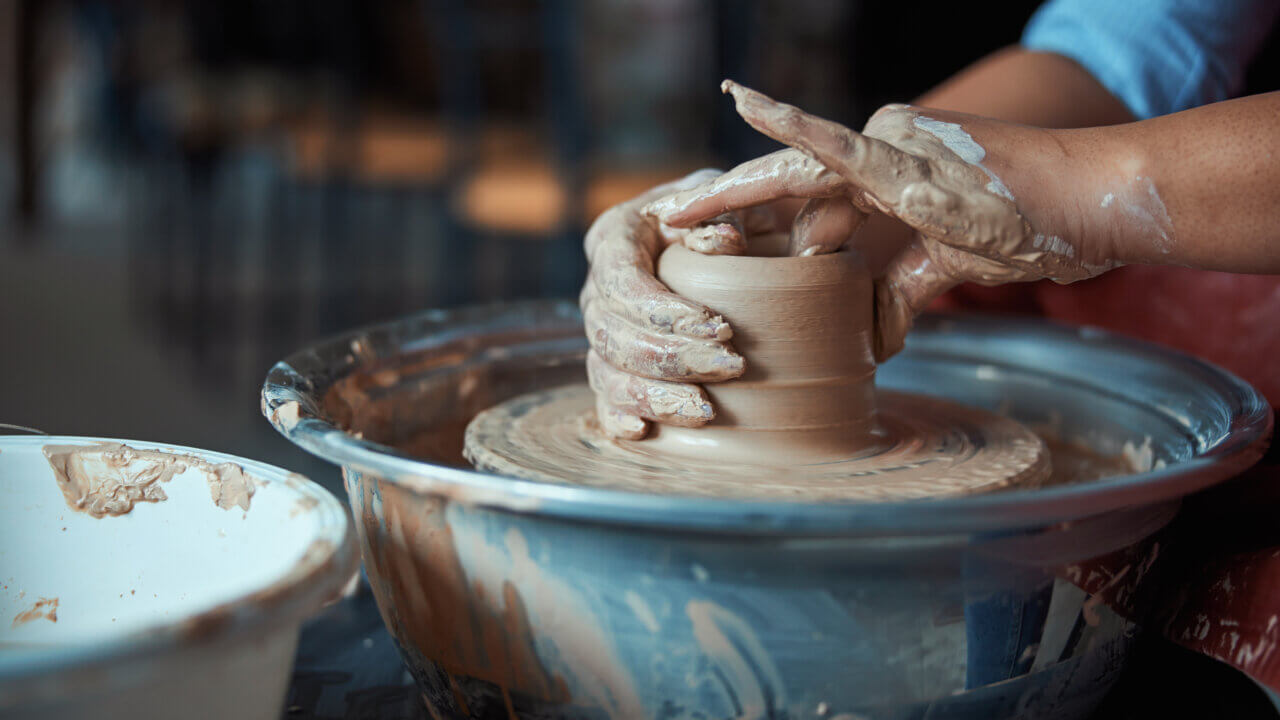
The pottery wheel was invented around 3500 BCE in Mesopotamia (modern-day Iraq), during the early Bronze Age. The earliest wheels were simple turntables, often called slow wheels or tournettes, that a potter rotated by hand. The true fast wheel, spun with enough momentum to throw a pot from a single lump of clay, developed roughly between 3000 and 2400 BCE in the same region.
That makes the potter’s wheel one of the oldest machines humans ever built. By most archaeological accounts, it’s older than the wheeled cart. Pottery itself is far older still; people had been hand-building pots for thousands of years before anyone thought to spin the clay.
Where Was the Pottery Wheel Invented?
The strongest archaeological evidence points to southern Mesopotamia, the land between the Tigris and Euphrates rivers. Excavations at Sumerian sites such as Ur and Uruk have turned up both wheel-thrown pottery and the heavy stone and clay wheel parts used to make it.
Why there? Mesopotamia around 3500 BCE had the right conditions: dense cities, abundant river clay, and real demand. Feeding and supplying a city takes an enormous number of storage jars, bowls, and cups, and hand-building couldn’t keep up. The wheel was a production tool first and an art tool much later.
Some historians argue the wheel may have been invented independently more than once. Early turntable devices show up in ancient Egypt, the Indus Valley, and China within centuries of the Mesopotamian finds. Whether those cultures invented it on their own or learned it through trade routes is still debated. What’s not debated is that Mesopotamia has the earliest solid evidence.
Who Invented the Pottery Wheel?
No one knows the individual, and we never will. Writing was only just being invented in Mesopotamia at the same time, so there’s no record naming a person. The pottery wheel almost certainly wasn’t a single “aha” invention anyway. It evolved gradually:
- Potters first built coil pots on mats or large leaves they could pivot to work all sides.
- Someone replaced the mat with a shallow dish or board on a pivot point: the tournette.
- Heavier wheel heads held momentum longer, and potters realized spinning the clay fast let them shape it with steady hands instead of building it up coil by coil.
So the honest answer to “who invented the pottery wheel” is: generations of anonymous Sumerian craftspeople, refining the same idea over a few hundred years.
Slow Wheel vs. Fast Wheel
Historians split early wheels into two stages, and the difference matters more than it sounds.
The slow wheel (tournette), from about 4500–3500 BCE, was a turntable rotated by hand or with a stick. It didn’t spin freely. The potter still built the pot from coils, using the rotation to smooth and true up the walls. It’s a helper, not a machine.
The fast wheel, from about 3000 BCE onward, used a heavy flywheel that stored momentum. Kicked or spun up to speed, it kept turning on its own long enough for the potter to center a lump of clay and pull up the walls in one continuous motion. That’s true throwing, the same basic skill you’d learn at a wheel today. If you’ve ever fought to get a lump running true, you know centering the clay is the skill the fast wheel made both possible and necessary.
The fast wheel changed the economics of pottery completely. A skilled thrower can produce a simple bowl in a minute or two; the same form hand-built from coils takes far longer. That speed turned pottery from a household chore into a specialized trade.
Timeline: How the Pottery Wheel Spread
| Approximate date | Region | Development |
|---|---|---|
| 4500–3500 BCE | Mesopotamia | Slow wheel / tournette in use |
| ~3500 BCE | Mesopotamia (Sumer) | Commonly cited date for the potter’s wheel |
| ~3000–2400 BCE | Mesopotamia | True fast wheel; throwing from the hump |
| ~2500 BCE | Indus Valley (Harappan civilization) | Wheel-thrown pottery widespread |
| ~2300–2000 BCE | Ancient Egypt | Wheel adopted; later turned by an assistant or foot |
| ~1500–1000 BCE | China | Fast wheel refines earlier turntable traditions |
| ~1000 BCE onward | Greece, the Levant, Europe | Wheel spreads with Iron Age trade |
| ~700 CE | Japan | Kick wheel arrives via Korea and China |
| Pre-1500s CE | The Americas | No potter’s wheel; all pottery hand-built until European contact |
That last row surprises people: the magnificent ceramics of the Maya, Moche, and Pueblo cultures were all made without a wheel, using coiling, paddle-and-anvil, and molds. It’s a good reminder that you can make pottery without a wheel. Potters did it brilliantly for millennia.
From Kick Wheel to Electric Wheel
The wheel you’d find in a studio today is the product of two more big leaps.
The kick wheel dominated from antiquity until the twentieth century. A heavy flywheel of stone, concrete, or weighted wood, often 100 lbs (45 kg) or more, sits low to the ground, connected by a shaft to the wheel head. The potter kicks the flywheel to build momentum, then throws while it coasts. Kick wheels are quiet, nearly indestructible, and many traditional potters in Japan, India, and elsewhere still swear by them.
The electric wheel arrived in the early-to-mid twentieth century, replacing leg power with a motor and a foot pedal for speed control. Modern electric wheels hold a set speed under load, reverse direction for left-handed throwers, and weigh little enough to move around a home studio. They top out around 240–300 RPM. I cover what those speeds mean for your throwing in how fast does a pottery wheel spin.
| Feature | Kick wheel | Electric wheel |
|---|---|---|
| Power source | Your legs and a flywheel | Motor with foot pedal |
| Speed control | Varies as it coasts; takes practice | Constant, precise, holds speed under load |
| Noise | Nearly silent | Quiet hum to noticeable whir, by model |
| Weight | Often 200+ lbs (90+ kg) | Roughly 60–130 lbs (27–60 kg) |
| Maintenance | Almost none; lasts generations | Motor, belt, and pedal eventually need service |
| Typical cost | Often cheap or free used; few made new | Roughly $400–$1,800+ new |
| Best for | Traditionalists, off-grid studios, big flywheel momentum | Most beginners and production potters |
If you’re shopping, I’ve broken down realistic budgets in how much are pottery wheels, Buying secondhand is often the smartest entry point, and how much is a used pottery wheel covers what to look for and what to pay.
Why the Pottery Wheel Mattered So Much
It’s hard to overstate the wheel’s impact on the ancient world:
- Mass production. Cities could be supplied with cheap, uniform storage jars, cookware, and tableware. Standardized vessels even made trade easier, since a jar of a known size held a known quantity of grain, oil, or wine.
- Specialization. Throwing takes years to master, so pottery became a full-time profession — one of the first specialized crafts, often organized into workshops and family lineages.
- Thinner, finer ware. Wheel-thrown walls can be thinner and more even than coiled ones, which means lighter pots that fire more reliably and use less clay and fuel.
- New forms. Tall narrow-necked jars, trimmed feet, thrown lids. Shapes that are awkward to hand-build became routine on the wheel.
Archaeologists still use the shift from hand-built to wheel-thrown pottery as a marker when dating sites, because the change shows up so clearly in the sherds left behind.
What This History Means for You at the Wheel
When I sit down to throw, I like remembering that the motion (center, open, pull) is essentially unchanged after 5,000 years. The motor replaced the kick, but the hands do the same work a Sumerian potter’s did.
A few practical takeaways from the history:
- Momentum is everything. Ancient potters built heavy flywheels because steady rotation makes centering easier. The modern equivalent: pick a wheel with enough motor torque that it doesn’t bog down when you lean on the clay.
- The wheel is for round things. It always was. For slab boxes, tiles, and sculpture, hand-building is still the right tool, exactly as it was before 3500 BCE.
- Start with the classics. Cylinders and bowls were the first wheel-thrown forms in history and they’re still the right place to begin. I’ve listed beginner-friendly projects in what to make on a pottery wheel.
FAQ: Pottery Wheel History
When was the pottery wheel invented?
Around 3500 BCE in Mesopotamia. Simple hand-turned turntables (slow wheels) existed even earlier, possibly by 4500 BCE, and the fast wheel capable of true throwing developed by roughly 3000–2400 BCE.
Where was the pottery wheel invented?
In southern Mesopotamia (present-day Iraq), among the Sumerian city-states such as Ur and Uruk. Egypt, the Indus Valley, and China adopted (or possibly independently developed) the wheel within the following thousand years.
Who invented the pottery wheel?
No individual inventor is known. The wheel evolved gradually from pivoted mats and turntables, refined by generations of anonymous Sumerian potters before written records could name anyone.
What did potters use before the wheel was invented?
Coiling, pinching, slab-building, and paddle-and-anvil techniques. They’re the same hand-building methods still taught today. Entire ceramic traditions, including all pre-Columbian pottery in the Americas, were built without a wheel.
Was the pottery wheel invented before the wheel for transport?
Most evidence says yes. Potter’s wheels appear in the archaeological record around 3500 BCE, slightly before or around the same time as the earliest wheeled vehicles, making the potter’s wheel one of humanity’s first rotating machines.
Are kick wheels still used today?
Yes. Traditional kick wheels remain in daily use in Japan, India, Korea, and plenty of Western studios. Many potters prefer the quiet, the slower pace, and the near-zero maintenance, though electric wheels dominate classrooms and production studios.