
What Type Of Clay Is Used For Pottery?
By Linda · · 7 min read
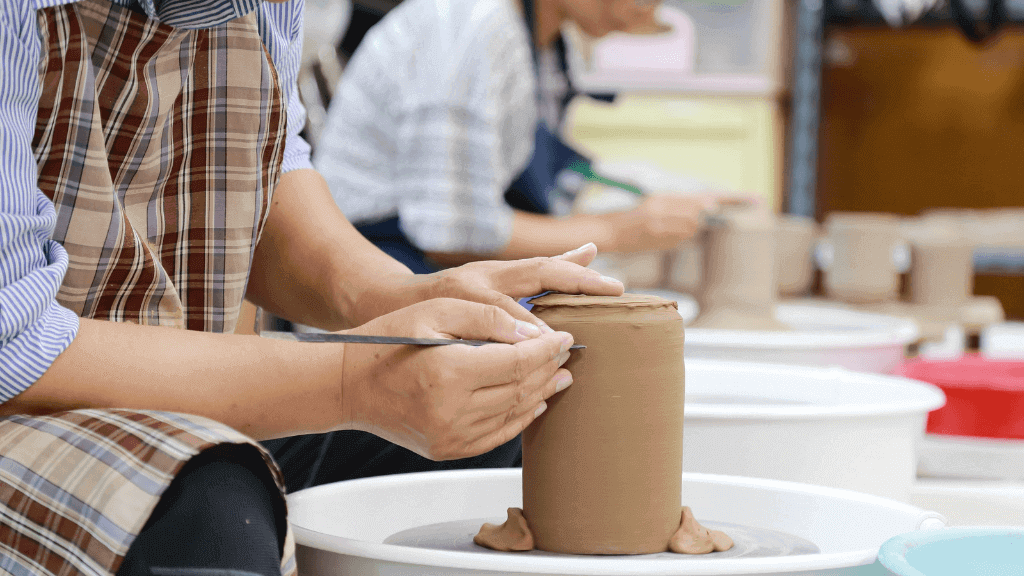
Pottery is made from three main clay bodies: earthenware, stoneware, and porcelain. Earthenware fires at low temperatures (around cone 06–04, or 1,830–1,940°F / 999–1,060°C) and stays porous unless glazed. Stoneware fires at mid to high temperatures (cone 5–10, roughly 2,165–2,345°F / 1,185–1,285°C) and becomes dense and watertight. Porcelain fires the hottest and turns white, smooth, and slightly translucent.
If you just want one recommendation: start with a mid-fire stoneware. It’s forgiving on the wheel, hard to overfire, and it makes mugs and bowls that stand up to daily use.
The Three Main Clay Bodies
Each clay body behaves differently in your hands, in the kiln, and in daily use. Here is how I explain them to new students.
Earthenware
Earthenware is the oldest and most common pottery clay in the world. Terracotta flower pots, Mexican folk pottery, and most historical pottery are earthenware.
- Fires low: typically cone 06–04 (1,830–1,940°F / 999–1,060°C)
- Usually red, orange, or buff from iron content
- Stays porous after firing, so it must be glazed to hold liquid
- Cheap and easy to work, which makes it a natural fit for hand building and school programs
The trade-off is durability. Earthenware chips more easily than stoneware, and unglazed pieces will weep water. Most backyard clay is essentially earthenware, too. I cover digging your own in whether you can use clay from the ground for pottery and whether red clay works for pottery.
Stoneware
Stoneware is the workhorse of functional pottery. Most handmade mugs, plates, and casserole dishes you see at craft fairs are stoneware.
- Fires mid to high: cone 5–6 (around 2,165–2,230°F / 1,185–1,221°C) or cone 10 (about 2,345°F / 1,285°C)
- Comes in white, buff, tan, speckled, and dark brown bodies
- Vitrifies: the clay particles fuse, so the fired piece is dense and watertight even before glazing
- Strong enough for dishwashers, microwaves, and daily abuse
This is what I throw with most days. A speckled cone 6 stoneware hides small glaze flaws and looks good with almost any glaze.
Porcelain
Porcelain is made primarily from kaolin, a very pure white clay. Fired high, it becomes glassy, bright white, and can be thin enough to let light through.
- Fires high: usually cone 6–10 (2,230–2,345°F / 1,221–1,285°C)
- Extremely smooth, fine-grained, and white
- The hardest body to work with. It’s less plastic, collapses easily on the wheel, and cracks if dried unevenly
- The most expensive of the three
I tell beginners to spend at least a year on stoneware before trying porcelain. It punishes sloppy technique, but nothing else gives you that luminous white surface.
Quick Comparison Table
| Clay body | Firing range | Typical color | Watertight when fired? | Best for | Difficulty |
|---|---|---|---|---|---|
| Earthenware | Cone 06–04 (1,830–1,940°F / 999–1,060°C) | Red, orange, buff | No (needs glaze) | Hand building, planters, decorative work | Easy |
| Stoneware | Cone 5–10 (2,165–2,345°F / 1,185–1,285°C) | White to dark brown, speckled | Yes | Functional dinnerware, mugs, bakeware | Easy–moderate |
| Porcelain | Cone 6–10 (2,230–2,345°F / 1,221–1,285°C) | Bright white | Yes | Fine tableware, translucent work | Hard |
What About Ball Clay, Fire Clay, and Kaolin?
You will see these names on bags at the pottery supplier, and they confuse a lot of beginners. They are raw ingredient clays, not finished clay bodies. Potters and manufacturers blend them to build a clay body with specific properties.
- Kaolin is the pure white primary clay that forms the backbone of porcelain. On its own it is not plastic enough to throw.
- Ball clay is extremely fine and plastic. It is added to clay bodies (including porcelain) to make them workable, but used alone it shrinks too much and cracks.
- Fire clay withstands very high temperatures. It adds tooth and heat resistance to stoneware bodies and is used for kiln bricks and sculpture bodies.
Unless you are mixing your own clay from dry materials, you never need to buy these separately. If that process interests you, I walk through it in how to make pottery clay.
How to Choose the Right Clay for Your Project
When a student asks me which clay to buy, I run through five questions:
- What kiln access do you have? Your clay’s cone rating must match the temperature your kiln (or your studio’s kiln) fires to. A cone 10 stoneware fired only to cone 06 will never vitrify; a cone 04 earthenware fired to cone 6 will melt and slump onto the kiln shelf.
- Wheel or hand building? Smooth bodies throw beautifully. Grogged bodies (clay with sand-like fired clay particles added) hold their shape for slabs and sculpture and crack less during drying.
- Functional or decorative? Anything that holds food or liquid is happiest in stoneware or porcelain. Decorative and garden pieces can be earthenware.
- What color do you want under the glaze? White bodies make glaze colors bright and true. Red and brown bodies mute and warm them.
- What does your glaze fit? Glazes are formulated for a temperature range. Match clay, glaze, and firing temperature and most problems disappear.
A 25 lb (11.3 kg) bag of commercial clay typically runs about $15–$40 depending on the body, with porcelain at the top end and basic earthenware at the bottom. I cover suppliers and what to look for in where to buy clay for pottery.
Best Clay for Beginners
Buy a mid-fire (cone 5–6) stoneware with a little grog. Here is why:
- It centers easily on the wheel and stands up in hand building.
- Cone 6 is the most common community-studio and electric-kiln firing range, so glazes and firing slots are easy to find.
- It forgives uneven drying far better than porcelain.
- Finished pieces are genuinely usable. Food safe with the right glaze, dishwasher tough.
Avoid porcelain for your first bag, and be cautious with very dark or heavily grogged sculpture bodies if you plan to throw. Coarse grog chews up your hands during long throwing sessions.
One more beginner note: air-dry clay and oven-bake polymer clay are not pottery clay. They never vitrify, so they are never food safe or truly waterproof. Real pottery clay needs a kiln, because a home oven only reaches about 500°F (260°C), nowhere near the 1,800°F+ (982°C+) needed to mature even earthenware. I explain the details in whether pottery clay can be baked in a regular oven.
Can You Mix Different Clays Together?
Yes, with care. Potters blend clays all the time. Wedging a smooth stoneware into a grogged one, for example, gets you a body that throws well but dries safely.
The rules that keep you out of trouble:
- Match firing ranges. Never blend a low-fire body into a high-fire one if you plan to fire high; the low-fire portion can bloat or melt.
- Match shrinkage. Clays shrink roughly 8–15% from wet to glaze-fired. Blending bodies with very different shrinkage invites cracks.
- Match moisture. Wedge clays together at the same softness or you will get a streaky, uneven lump.
- Test first. Make a small tile of the blend, fire it through your full cycle, and check for cracking, warping, and color before committing a whole batch.
Mixing contrasting colored clays on purpose (agateware) is a lovely technique, but the same shrinkage rules apply.
Storing Clay So It Stays Usable
Whatever clay you choose, keep it in its sealed bag inside a lidded bucket or tote, away from freezing temperatures. Moist clay keeps for years this way; it does not really expire, though it can dry out or grow harmless surface mold. If your bag has gone hard or smelly, don’t toss it. See can pottery clay go bad for how I revive it.
FAQ
What is the most common clay used for pottery?
Stoneware is the most common clay among working potters and studios today because it is durable, watertight when fired, and easy to work. Earthenware is the most common historically and is still standard for terracotta and folk pottery.
What clay should a beginner use for pottery?
A cone 5–6 mid-fire stoneware with fine grog. It is affordable, forgiving on the wheel and in hand building, and fires in any standard electric kiln. Save porcelain for later.
What is the difference between earthenware, stoneware, and porcelain?
Firing temperature and density. Earthenware fires low (cone 06–04) and stays porous; stoneware fires mid to high (cone 5–10) and vitrifies watertight; porcelain fires high, vitrifies, and is white and slightly translucent. Higher firing generally means a stronger finished pot.
Can you use natural clay from the ground for pottery?
Often yes. Most dug clay is a low-fire earthenware that needs cleaning, sieving, and testing before use. Expect to remove rocks and roots, adjust plasticity, and test-fire small pieces to find its maturing temperature.
Is air-dry clay the same as pottery clay?
No. Air-dry clay hardens by evaporation and never vitrifies, so it stays fragile and water-soluble. Pottery clay must be kiln-fired to at least about 1,830°F (999°C) to become ceramic.
What type of clay is used for pottery wheels?
Any earthenware, stoneware, or porcelain works on the wheel, but smooth or finely grogged stoneware is easiest to center and pull. Heavily grogged sculpture bodies are rough on the hands, and porcelain demands precise technique.